Our Short List of 3

- Frame: Aluminium, hard tail, front suspension
- Battery: 48V, 374Wh
- Motor: Peak 750W
- Stated range: Up to 55 miles
- Frame: High-strength steel, hard tail
- Motor: 750W peak
- Stated top speed: 20 mph
- Stated range: Up to 40 miles

- Frame: Hard tail, per the product page
- Motor: 350W
- Stated top speed: 20 mph
- Stated range: Up to 40 miles
All 4 Picks at a Glance
| Product | Specs | Action |
|---|---|---|
| 1. ANCHEER Sunshine 26-Inch Electric Mountain Bike (AMAK00026) |
| Check price on Amazon |
| 2. Hoverfly OUREA 26-Inch Electric Mountain Bike |
| Check price on Amazon |
| 3. QNUT Victor 26-Inch Electric Mountain Bike |
| Check price on Amazon |
 4. REOCRO E26 26-Inch Electric Mountain Bike |
| Check price on Amazon |
Key takeaways
- Compare hardtail electric mountain bikes with front suspension, removable batteries and trail-ready gears to find the right fit for your riding style.
As an Amazon Associate we earn from qualifying purchases.
A hardtail electric mountain bike pairs a rigid rear end with a suspension fork up front, and that simple layout is exactly why so many riders choose one. There is no rear shock to maintain, the frame transfers pedal power directly to the rear wheel, and the motor and battery do the heavy lifting on climbs that would otherwise end a ride early. For fire roads, singletrack, gravel paths and the ride to the trailhead, a hardtail e-MTB is often the most practical electric mountain bike format there is.
This guide compares four hardtail electric mountain bikes sold on Amazon US. Every model below was checked against its Amazon product page, and every page states a hard tail frame type together with an electric motor, so there are no full-suspension bikes and no pedal-only mountain bikes mixed into the list. The four picks differ in motor output, battery capacity, frame material and gearing, which gives you a genuine choice rather than four versions of the same bike.
Disclosure: This article contains affiliate links. If you buy through these links, we may earn a commission at no additional cost to you.
How to Choose a Hardtail Electric Mountain Bike
Understand what hardtail means
A hardtail frame has suspension at the front fork and a rigid rear triangle. On an Amazon product page this usually appears as a frame type of Hard Tail paired with a front suspension type. That combination matters because it tells you how the bike will behave: the fork absorbs impacts from roots and rocks at the front wheel, while the rigid rear keeps pedalling efficient and the frame simpler and lighter than a dual-suspension design. If a listing shows dual suspension, it is not a hardtail, whatever the marketing headline says.
Match motor output to your terrain
The motors in this guide range from a modest 350W unit to peak outputs of 750W. A smaller motor suits flatter trails, bike paths and lighter riders, and it usually keeps the bike easier to handle at low speed. A stronger motor helps on sustained climbs, loose surfaces and rides where you carry a pack. Remember that the figure a listing leads with is often a peak rating rather than a continuous one, so compare the battery and gearing alongside the motor rather than choosing on wattage alone.
Read the battery in watt-hours
Battery capacity, expressed in watt-hours, is the fairest way to compare range between models. A 374Wh pack is a lighter, shorter-ride option, while a 480Wh or 499Wh-class pack supports longer trail days. Removable batteries are worth prioritising if you charge indoors, store the bike in a garage without a socket nearby, or want to reduce theft risk by taking the pack with you. Stated range figures always assume favourable conditions, so treat them as a ceiling and expect less on steep, cold or heavily assisted rides.
Check wheels, gears and brakes
All four bikes here use 26-inch wheels, which keep the handling quick and the overall bike compact. Wider tyres add grip and cushioning on loose ground, which partly offsets the rigid rear end. Gearing matters more on an e-MTB than many buyers expect: a 21-speed setup gives you a low gear for climbing when the battery runs low, while a 7-speed setup is simpler and perfectly workable where the motor does most of the work. Disc brakes, ideally at both wheels, are the sensible minimum for a heavier electric bike descending on dirt.
Confirm certification and fit
Look for recognised electrical certification such as UL 2849 where a listing states it, and check the stated rider height range and maximum weight recommendation against your own measurements. A hardtail that fits well, with a saddle height you can set correctly and a reach that feels natural, will always ride better than a more powerful bike in the wrong size.
The Picks
1. ANCHEER Sunshine 26-Inch Electric Mountain Bike (AMAK00026)
- Frame: Aluminium, hard tail, front suspension
- Battery: 48V, 374Wh
- Motor: Peak 750W
- Stated range: Up to 55 miles
The ANCHEER Sunshine is the most complete all-rounder in this group. Its Amazon page states a hard tail frame type, front suspension and an aluminium frame, with a 26-inch wheel size. Power comes from a motor with a peak output of 750W, fed by a 48V battery rated at 374Wh, and ANCHEER states a range of up to 55 miles with a top speed in the 20 to 22 mph band. The listing also states UL 2849 compliance, which is a reassuring detail on any electric bike.
The drivetrain offers 7 and 21-speed configurations, and braking is by disc brakes. That combination makes the Sunshine a good fit for riders who split their time between trails and everyday riding: the gearing gives you options when the trail tilts upward, the front fork takes the sting out of rough surfaces, and the aluminium frame keeps the bike manageable when you need to lift it onto a rack or carry it up steps.
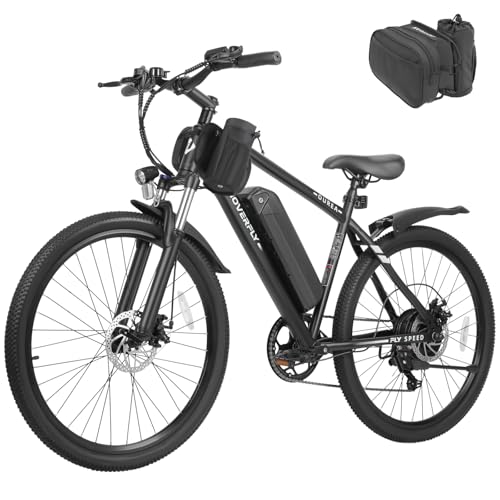
2. Hoverfly OUREA 26-Inch Electric Mountain Bike
- Frame: High-strength steel, hard tail
- Motor: 750W peak
- Stated top speed: 20 mph
- Stated range: Up to 40 miles
The Hoverfly OUREA takes a different route to the same hardtail formula. Its Amazon page states a hard tail frame type and a high-strength steel frame, which will appeal to riders who prioritise frame toughness. The motor peaks at 750W, the stated top speed is 20 mph, and the stated range reaches up to 40 miles from a removable battery. The listing describes a 7-speed drivetrain, a shock-absorbing front end and fat tyres, and states UL 2849 certification.
Fat tyres are a sensible match for a hardtail, because the extra air volume works as a small amount of rear-end cushioning that the rigid frame does not provide. On sand, gravel and broken surfaces that extra footprint also adds confidence. If your riding leans toward mixed surfaces rather than groomed singletrack, the OUREA is the pick in this list that is built most clearly around that brief.
3. QNUT Victor 26-Inch Electric Mountain Bike
- Frame: Hard tail, per the product page
- Motor: 350W
- Stated top speed: 20 mph
- Stated range: Up to 40 miles
The QNUT Victor is the lightest-powered option here, and that is a deliberate strength rather than a compromise. Its Amazon page states a hard tail frame type, a 350W motor, 26-inch wheels, a 21-speed drivetrain, a top speed of 20 mph and a range of up to 40 miles, with dual disc brakes for stopping. The listing also describes three riding modes: pedal assist, a walking mode and regular bicycle mode.
That mode choice, together with the wide 21-speed gear range, makes the Victor a sensible first electric mountain bike. When assistance is off or the battery is low, you still have low gears to get home on, and when assistance is on, the smaller motor delivers its help gently. Riders who mostly ride flatter trails, towpaths and gentle off-road routes will rarely miss the extra output of the stronger motors in this guide.
4. REOCRO E26 26-Inch Electric Mountain Bike
- Frame: High carbon steel, hard tail, front fork suspension
- Battery: 48V, 480Wh, removable
- Motor: 750W peak
- Stated top speed: 25 mph
The REOCRO E26 is the range-focused pick. Its Amazon page states a bike type of mountain bike, a hard tail frame type, a high carbon steel frame and front fork suspension. The motor peaks at 750W, and the removable battery is rated at 48V and 480Wh, the largest capacity in this guide. REOCRO states a top speed of 25 mph and a pedal-assist range of 30 to 50 miles, and the drivetrain is a 7-speed setup.
The bigger battery is the headline here. If your rides are long, your routes are hilly, or you simply want to charge less often, the extra watt-hours are worth more than any other single specification. The trade-off is a steel frame and a simpler 7-speed drivetrain, so the E26 suits riders who value distance and motor support over a wide spread of pedal gears.
Comparison Table
| Model | ASIN | Wheel Size | Motor | Battery | Stated Range | Gearing | Frame |
|---|---|---|---|---|---|---|---|
| ANCHEER Sunshine | B0GL29X35T | 26 inch | Peak 750W | 48V 374Wh | Up to 55 miles | 7/21 speed | Aluminium hard tail |
| Hoverfly OUREA | B0FDWZV38C | 26 inch | 750W peak | Removable | Up to 40 miles | 7-speed | Steel hard tail |
| QNUT Victor | B0FGXPTPWW | 26 inch | 350W | Not stated in watt-hours | Up to 40 miles | 21-speed | Hard tail |
| REOCRO E26 | B0FPCH7RN4 | 26 inch | 750W peak | 48V 480Wh removable | 30 to 50 miles pedal assist | 7-speed | Carbon steel hard tail |
Frequently Asked Questions
What is the difference between a hardtail and a full-suspension electric mountain bike?
A hardtail has a suspension fork at the front and a rigid rear end, while a full-suspension bike also has a rear shock. Hardtails are simpler, usually lighter, and transfer pedal power more directly, which suits climbs, fire roads and moderate trails. Full-suspension bikes add comfort and control on very rough descents, at the cost of more maintenance and more weight.
Are hardtail electric mountain bikes good for beginners?
Yes. The simpler frame, predictable handling and lower maintenance demands make hardtails a forgiving place to start. A model with a wide gear range, like the 21-speed options in this guide, is especially helpful while you learn, because you can keep pedalling comfortably even with assistance turned down or off.
How far can a hardtail e-MTB go on one charge?
It depends mainly on battery capacity, terrain, rider weight and assist level. The bikes in this guide state ranges from up to 40 miles to up to 55 miles. Treat every stated figure as a best case, and expect a shorter distance on steep trails or in cold weather.
Does front suspension alone handle rough trails?
For moderate trails, gravel and forest roads, a front fork combined with sensibly wide tyres handles most of what riders encounter. On very rocky or root-heavy descents you will feel the rigid rear end more, and riding at a controlled speed with your weight balanced makes a noticeable difference.
What should I check before ordering?
Confirm the frame type states hard tail, check the wheel size and stated rider fit, look at the battery capacity in watt-hours, and note whether the battery is removable if you need to charge it away from the bike. Also check for stated electrical certification such as UL 2849 where that matters to you.
Conclusion
Each of the four bikes in this guide is a genuine hardtail electric mountain bike, with the frame type and electric drive both stated on its Amazon page. Choose the ANCHEER Sunshine for the most balanced specification and stated certification, the Hoverfly OUREA for a steel frame and fat tyres, the QNUT Victor for a gentler motor and a wide 21-speed gear range, and the REOCRO E26 for the largest battery and longest stated pedal-assist range. Match the motor and battery to the terrain you actually ride, and a hardtail e-MTB will cover it with less fuss than almost any other bike format.