Our Short List of 3

- Best for: Daily-driven 2012 Civics that follow the Maintenance Minder.
- Viscosity: 0W-20
- Volume: 5 quart (160 fl oz)
- Formula: Triple Action Formula, full synthetic
- Protection figure on listing: 10,000 miles between oil changes

- Best for: Civics that spend long stretches at highway speed or in hot climates.
- Viscosity: 0W-20
- Volume: 5 quarts
- Claim on listing: 3X stronger against viscosity breakdown
- Model: 03124

- Best for: Owners who want a mainstream jug with its protection claims printed in numbers.
- Viscosity: 0W-20
- Volume: 5 QT (160 fl oz)
- Credentials on listing: ILSAC GF-6A, API SP, GM dexos1 Gen 3
- Claims on listing: 40 percent better wear protection, 25 percent better deposit protection than industry standards
All 5 Picks at a Glance
| Product | Specs | Action |
|---|---|---|
| Mobil 1 Advanced Fuel Economy 0W-20 |
| Check price on Amazon |
| Castrol EDGE 0W-20 |
| Check price on Amazon |
| Valvoline Advanced Full Synthetic 0W-20 |
| Check price on Amazon |
 Idemitsu IFG3 0W-20 |
| Check price on Amazon |
 Pennzoil Platinum 0W-20 |
| Check price on Amazon |
Key takeaways
- The 2012 Honda Civic takes 0W-20 full synthetic and just under four quarts. Compare five jugs by formula, credentials and pack size before you buy.
A 2012 Civic is old enough that its oil choice carries real consequences, yet the decision itself is narrow. Honda built the ninth-generation car around 0W-20 full synthetic, and the 1.8-liter engine’s clearances, variable valve timing and fuel-economy calibration all assume that thin grade. The real decision is not the grade, that is settled, but which formula you trust for the next interval: a mainstream jug, a factory-style option, or a multi-pack that covers several changes at once.
This roundup is for 2012 Civic owners who change their own oil in the driveway, owners of higher-mileage cars deciding whether deposits deserve a dedicated formula, and Si drivers whose 2.4-liter asks the same 0W-20 grade to work harder. Every pick was chosen from the name and specifications printed on its Amazon listing, and each one is a full synthetic 0W-20 in packaging that suits a sump holding just under four quarts.
Quick Picks
As an Amazon Associate we earn from qualifying purchases
| Product | Best for | Key spec from title |
|---|---|---|
| Mobil 1 Advanced Fuel Economy 0W-20 | The default choice for daily driving | 0W-20, 5-quart jug |
| Castrol EDGE 0W-20 | Highway running and hot climates | 0W-20, 5 quarts |
| Valvoline Advanced Full Synthetic 0W-20 | Deposit and wear protection in print | 0W-20, 5 QT |
| Idemitsu IFG3 0W-20 | The newest credential set, Japanese brand | 0W-20, 5 quart, API SP / GF-7A |
| Pennzoil Platinum 0W-20 | Stocking three changes at once | 0W-20, case of three 5-quart jugs |
How to Choose
Confirm the grade before comparing brands
The 2012 Civic was one of the Honda models built firmly around 0W-20. The grade is printed on the filler cap, and it applies across the range: the 1.8-liter in the LX, EX and EX-L, the 2.4-liter in the Si, and the hybrid all run the same thin full synthetic. Owners coming from an older Civic that drank 5W-20 need to drop that habit here, because the newer engine’s oil pump, bearing clearances and valve-timing hardware were calibrated for the lighter grade. Brand arguments only start once the grade on the jug matches the cap.
Read the credentials printed on the listing
Beyond the words full synthetic, the listing’s credential lines tell you how current a formula is. Look for API SP and an ILSAC grade of GF-6A or the newer GF-7A, since those categories added timing-chain wear control and protection against low-speed pre-ignition for modern engines. A 2012 engine predates some of those worries, but a current credential set still signals a current blend rather than an old formulation in a fresh label. If a listing hides behind vague language and prints no credentials at all, treat that as a reason to pick a rival jug whose specifications are stated in full.
Size the purchase to a four-quart sump
The 1.8-liter Civic takes just under four quarts with a filter change, which makes the common 5-quart jug a natural fit: one full change plus a reserve for topping up between services. Single quarts make sense only as top-up stock. A case of three jugs is a different commitment, roughly three changes on the shelf, and it suits owners who service the car themselves on a fixed rhythm or keep a second 0W-20 vehicle in the household. Buying more oil than your routine will use in a reasonable span just trades shelf space for no benefit.
Match the formula to the car’s age
A 2012 car is well into its second decade, so the formula question is partly about what has already happened inside the engine. A healthy engine that has followed its Maintenance Minder all its life needs nothing exotic, and a mainstream full synthetic is the honest pick. An engine with years of short trips, unknown history or early oil consumption argues for a formula whose listing talks about deposits and cleaning, and for a shorter leash on level checks. What no formula can do is repair wear that is already there, so let the car’s condition, not the label art, drive the choice.
The 5 Best Options
Mobil 1 Advanced Fuel Economy 0W-20
- Best for: Daily-driven 2012 Civics that follow the Maintenance Minder.
- Viscosity: 0W-20
- Volume: 5 quart (160 fl oz)
- Formula: Triple Action Formula, full synthetic
- Protection figure on listing: 10,000 miles between oil changes
Daily-driven 2012 Civics that follow the Maintenance Minder.
The same oil also appears in multi-packs under separate listings, so confirm you are ordering the single 5-quart jug.
Mobil 1 Advanced Fuel Economy 0W-20 is the straightforward starting point for a 2012 Civic, built around the two things this car asks of its oil: easy cold flow and steady economy over a long interval. The listing centers on the Triple Action Formula and a protection figure of 10,000 miles between changes, which pairs sensibly with the Civic’s Maintenance Minder rather than fighting it. The 5-quart jug covers the just-under-four-quart sump with a useful reserve left for topping up, and because this is Mobil 1’s mainstream line, matching the same jug again at the next change is simple.
Castrol EDGE 0W-20
- Best for: Civics that spend long stretches at highway speed or in hot climates.
- Viscosity: 0W-20
- Volume: 5 quarts
- Claim on listing: 3X stronger against viscosity breakdown
- Model: 03124
Civics that spend long stretches at highway speed or in hot climates.
Castrol sells several look-alike 0W-20 lines, so match the EDGE name and part number rather than the bottle color.
Castrol EDGE 0W-20 leads its listing with a strength claim, three times stronger against viscosity breakdown, which speaks to the way thin 0W-20 oils get worked hard at sustained highway speed and in summer heat. For a Civic that merges onto a freeway twice a day or lives in a hot state, that resistance to thinning is the relevant number on the page. The 5-quart format matches the car’s sump the same way the other jugs here do, with a little left over. EDGE is Castrol’s flagship car line, positioned above its GTX and Magnatec ranges, so read the label carefully when comparing across the brand.
Valvoline Advanced Full Synthetic 0W-20
- Best for: Owners who want a mainstream jug with its protection claims printed in numbers.
- Viscosity: 0W-20
- Volume: 5 QT (160 fl oz)
- Credentials on listing: ILSAC GF-6A, API SP, GM dexos1 Gen 3
- Claims on listing: 40 percent better wear protection, 25 percent better deposit protection than industry standards
Owners who want a mainstream jug with its protection claims printed in numbers.
Valvoline’s Extended Protection line sits one step up in the same range, so confirm the Advanced name on the listing before ordering.
Valvoline Advanced Full Synthetic 0W-20 prints the most numbers of any listing in this roundup: 40 percent better wear protection and 25 percent better deposit protection than industry standards, plus a claim of 24 times stronger protection against contaminants. For the owner of an aging Civic who wants the case for a jug made in figures rather than adjectives, that is the appeal. The credential line is current as well, covering ILSAC GF-6A, API SP and GM dexos1 Gen 3, and the 5-quart jug is sized for exactly the kind of four-cylinder sump this Honda carries.
Idemitsu IFG3 0W-20
- Best for: Owners who want the newest ILSAC credential set and a Japanese-brand formula.
- Viscosity: 0W-20
- Volume: 5 quart
- Credentials in product name: API SP, ILSAC GF-7A
- Line: IFG3, full synthetic
Owners who want the newest ILSAC credential set and a Japanese-brand formula.
Idemitsu also lists this oil in a 1-quart bottle and in an earlier GF-6A version, so confirm the 5-quart GF-7A listing before ordering.
Idemitsu IFG3 0W-20 is the pick for owners who like their Honda running a Japanese formula. Idemitsu is a Japanese lubricant specialist long associated with the oils Japanese makers use at the factory, and its IFG3 line is blended for fuel efficiency and engine protection in exactly this class of engine. The listing carries the newest credential set in this roundup, API SP with ILSAC GF-7A, one step past the GF-6A jugs above. The 5-quart jug covers a Civic change with reserve, and the brand’s lower profile means the listing, not shelf familiarity, has to do the convincing.
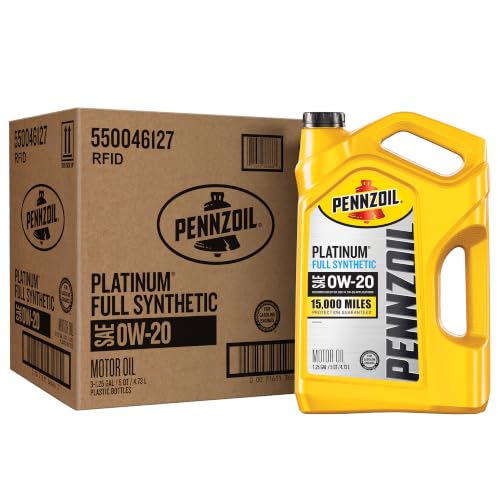
Pennzoil Platinum 0W-20
- Best for: DIY owners who change on schedule and would rather stock three changes at once.
- Viscosity: 0W-20
- Pack: case of three 5-quart jugs
- Base oil: PurePlus, made from natural gas
- Protection guarantee on listing: 15,000 miles
DIY owners who change on schedule and would rather stock three changes at once.
A case means fifteen quarts stored in the garage, so choose it only if the storage space and the follow-up changes are genuinely planned.
Pennzoil Platinum 0W-20 is sold here as a case of three 5-quart jugs, which changes the buying question from which oil to how you plan your year. The formula is Pennzoil’s PurePlus line, made from natural gas rather than crude oil, and the listing attaches a protection guarantee of 15,000 miles to it, the longest figure in this roundup. For a Civic that takes just under four quarts a change, one case covers three full services with top-up oil to spare, which suits owners who change their own oil on schedule and would rather not reorder every time.
Which One Fits Your Situation
You commute daily and let the Maintenance Minder call the changes
Take the Mobil 1 Advanced Fuel Economy. Its 10,000-mile protection figure sits comfortably alongside the intervals the Civic’s own minder tends to set, the jug size matches the sump, and reordering the identical oil next time takes no thought at all. For a car whose job is simply to start every morning and sip fuel, that lack of drama is exactly the point.
Your Civic lives on the highway or in a hot state
Choose the Castrol EDGE. Sustained speed and heat are what thin a 0W-20 oil down over an interval, and the EDGE listing’s viscosity-breakdown claim is aimed squarely at that failure mode. The Valvoline Advanced is a reasonable second choice if you prefer its printed wear figures. Either way, check the level monthly, because highway engines that burn a little oil rarely announce it early.
You want the closest thing to a factory-style fill
Go with the Idemitsu IFG3. It pairs a Japanese formula from a maker associated with factory fills with the newest credentials in the group, GF-7A, which makes it the natural pick for an owner who values originality over brand recognition at the parts counter. It is also the quiet choice for anyone keeping a well-preserved Civic as close to its original specification as possible.
You change the oil yourself and plan a year ahead
Buy the Pennzoil Platinum case. Three jugs cover three changes on a car that sips just under four quarts at a time, the per-change routine stays identical, and the 15,000-mile protection guarantee on the listing gives each interval comfortable headroom. The case also leaves a partial jug on the shelf for top-ups, which older engines tend to need sooner or later.
Common Mistakes
- Buying 5W-20 out of habit from an older Honda, when the 2012 Civic’s filler cap and manual both call for 0W-20.
- Pouring the entire 5-quart jug into a sump that takes just under four quarts, instead of filling to the dipstick marks.
- Stretching the interval far past the Maintenance Minder because the oil is full synthetic and the jug prints a long protection figure.
- Ordering a look-alike line from the same brand, such as a GTX or Extended Protection variant, when the listing you compared was a different formula.
- Never checking the dipstick between changes on a 14-year-old engine, even though older engines can consume oil gradually.
Frequently Asked Questions
What oil does a 2012 Honda Civic take?
Honda specifies 0W-20 full synthetic for the 2012 Civic, and the grade is printed on the filler cap. That covers the 1.8-liter cars, the 2.4-liter Si and the hybrid. Every jug in this roundup matches that specification, so the choice among them comes down to formula, credentials and pack size rather than grade.
How much oil does the 2012 Civic hold?
The 1.8-liter engine takes just under four quarts with a filter change, which is why the 5-quart jug is the practical format: it covers the change and leaves a reserve for topping up. Fill gradually near the end and confirm the level on the dipstick rather than pouring by the number alone.
Can I use 5W-20 if 0W-20 is not available?
For a full oil change, stick with the 0W-20 the car was built around, since the engine’s clearances and valve timing assume that grade. If you only need a top-up between changes and 5W-20 is all the shelf has, a quart will not upset anything, but return to 0W-20 at the next full change.
How often should I change the oil in a 2012 Civic?
Follow the Maintenance Minder on the dashboard, which tracks your actual driving pattern instead of a fixed distance. Short trips, cold starts and stop-and-go driving shorten what it allows, while steady highway use stretches it. Full synthetic oil supports those intervals; it is not a reason to ignore the minder and invent longer ones.