Our Short List of 3
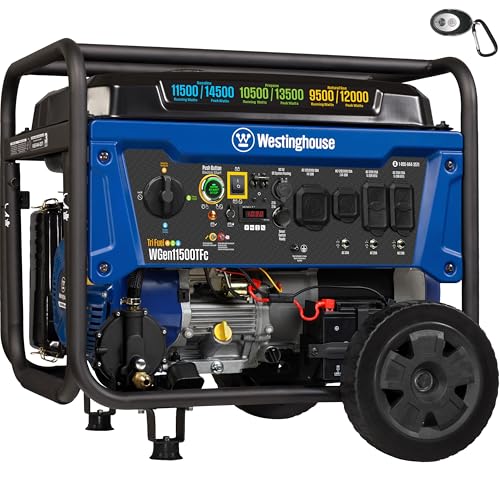
- Best for: Larger homes that want the strongest natural gas output in this group.
- Fuel types listed: gasoline, propane, and natural gas
- Gasoline output listed: 14,500 peak watts and 11,500 running watts
- Propane output listed: 13,500 peak watts and 10,500 running watts
- Natural gas output listed: 12,000 peak watts and 9,500 running watts

- Best for: Homeowners who want total run hours shown on a digital multimeter.
- Fuel types listed: gasoline, propane, and natural gas
- Output listed in title: 13,000 watts
- Gasoline output listed: 13,000 peak watts and 10,500 running watts
- Propane output listed: 12,500 peak watts and 10,000 running watts

- Best for: Modest backup loads where a compact tri-fuel machine is enough.
- Model listed: 201223
- Fuel types listed: gasoline, propane, and natural gas
- Gasoline output listed: 5,000 starting watts and 4,000 running watts
- Propane output listed: 4,500 starting watts and 3,600 running watts
All 4 Picks at a Glance
| Product | Specs | Action |
|---|---|---|
| Westinghouse WGen11500TFc Tri-Fuel Generator |
| Check price on Amazon |
| DuroMax XP13000HXT Tri-Fuel Generator |
| Check price on Amazon |
| Champion 201223 Tri-Fuel Generator |
| Check price on Amazon |
 Pulsar PGD105TiSCO Tri-Fuel Inverter Generator |
| Check price on Amazon |
Key takeaways
- Compare tri-fuel generators that run on gasoline, propane, and natural gas, each with a meter or display for tracking run hours and maintenance timing.
Choosing a tri-fuel generator is really a decision about which fuel you will actually have on hand when the power fails, and whether you can prove how many hours the machine has run when service is due. A unit plumbed into a natural gas line behaves very differently from one fed by portable propane tanks, and the running wattage drops each time you step away from gasoline. The hour meter matters because oil changes and valve checks follow run time, not calendar time.
This guide is for homeowners planning whole-house backup, people in areas where gasoline storage is restricted, and anyone who wants a machine that can switch fuels mid-outage. Every model below was picked from its Amazon product name and listing details, which state the three fuel types, the output for each fuel, and a display or meter function.
Quick Picks
As an Amazon Associate we earn from qualifying purchases
| Product | Best for | Key spec from title |
|---|---|---|
| Westinghouse WGen11500TFc Tri-Fuel Generator | Large homes needing the highest output on all three fuels | 14,500 peak watts on gasoline, remote electric start |
| DuroMax XP13000HXT Tri-Fuel Generator | Buyers who want a digital multimeter tracking total hours | 13,000 watts, 500cc engine, CO Alert |
| Champion 201223 Tri-Fuel Generator | Smaller homes and lighter backup loads on a compact frame | 5,000 starting watts and 4,000 running watts on gasoline |
| Pulsar PGD105TiSCO Tri-Fuel Inverter Generator | Anyone wanting inverter output plus a 50-amp connection | 10,500-watt tri-fuel inverter with remote start |
How to Choose
Compare Running Watts on the Fuel You Will Use Most
Start with the fuel you expect to burn for the longest stretch, then read that column of the listing and ignore the headline number. Gasoline almost always gives the highest output, propane sits in the middle, and natural gas delivers the least, sometimes by a wide margin. A generator that looks generous on gasoline may only just cover a well pump and furnace blower once it is connected to a natural gas line. Add up the running loads you refuse to lose, include the starting surge of the largest motor, and leave headroom rather than buying exactly to the total.
Decide What the Meter Needs to Show You
A basic hour meter simply counts total run time, which is enough to schedule oil and filter work if you check it after every outage. Richer displays add session hours, voltage, and frequency, so you can spot a machine that is running but delivering poorly. Think about who will read it: a homeowner glancing at a panel during a storm needs big, plain numbers, while someone maintaining a rental property may prefer a display that also flags the next service point. Confirm on the listing that the meter or digital display is part of that exact model, since similar model names often sit in the same range with different panels.
Match the Outlet Panel to Your Connection Plan
Output on paper means little if the panel cannot feed your house the way you intend. A transfer-switch setup usually calls for a 50-amp or 30-amp 240-volt outlet, while corded backup relies on several ordinary household receptacles, ideally ground-fault protected. Check the listing for the exact outlet mix, and note whether a propane hose and natural gas hose are included or bought separately. Also confirm the panel layout leaves room for bulky plugs side by side. Buying the right panel now avoids adapters and improvised wiring later, which is where many backup plans quietly fall apart.
Plan Fuel Storage, Noise, and Placement Together
Tri-fuel flexibility only helps if the fuel is stored safely and the machine can sit where exhaust cannot reach living space. Propane keeps well in tanks, gasoline needs rotation and approved containers, and natural gas depends on a line and fittings installed for the purpose. Open-frame models are generally louder than enclosed inverter designs, so placement distance from bedrooms matters during overnight runs. Every generator belongs outdoors, well away from windows and doors, with the exhaust pointed away from the building. Treat clearance, weather cover, and carbon monoxide shutoff features as part of the purchase decision, not accessories to consider afterward.
The 4 Best Options
Westinghouse WGen11500TFc Tri-Fuel Generator
- Best for: Larger homes that want the strongest natural gas output in this group.
- Fuel types listed: gasoline, propane, and natural gas
- Gasoline output listed: 14,500 peak watts and 11,500 running watts
- Propane output listed: 13,500 peak watts and 10,500 running watts
- Natural gas output listed: 12,000 peak watts and 9,500 running watts
Larger homes that want the strongest natural gas output in this group.
Confirm the hour display layout on the listing photos, and plan help for moving a machine of this size.
This is the heavy lifter of the group, aimed at owners who want one portable machine to carry a large home through a long outage without rationing circuits too hard. Its output stays strong even after the drop to propane or natural gas, which suits households that plan to leave gasoline as the last resort. Remote electric start also helps when the generator lives at the side of the house and the weather is foul. Buyers with a transfer switch will appreciate that the listing describes it as transfer switch ready.
DuroMax XP13000HXT Tri-Fuel Generator
- Best for: Homeowners who want total run hours shown on a digital multimeter.
- Fuel types listed: gasoline, propane, and natural gas
- Output listed in title: 13,000 watts
- Gasoline output listed: 13,000 peak watts and 10,500 running watts
- Propane output listed: 12,500 peak watts and 10,000 running watts
Homeowners who want total run hours shown on a digital multimeter.
Output falls on natural gas, so size your essential loads against that lower figure.
DuroMax pitches this model squarely at whole-home backup, and its panel is the clearest fit for the runtime meter requirement. The digital multimeter described for this range reports voltage, frequency, and total hours run, which makes service tracking straightforward after a season of short outages. Fuel changes happen at the front panel by turning a selector, so switching from an empty gasoline tank to propane does not mean working around the back of a hot machine. It suits owners who want a transfer-switch-ready 50-amp outlet and a carbon monoxide alert in one package.
Champion 201223 Tri-Fuel Generator
- Best for: Modest backup loads where a compact tri-fuel machine is enough.
- Model listed: 201223
- Fuel types listed: gasoline, propane, and natural gas
- Gasoline output listed: 5,000 starting watts and 4,000 running watts
- Propane output listed: 4,500 starting watts and 3,600 running watts
Modest backup loads where a compact tri-fuel machine is enough.
There is no 240-volt whole-house headroom here for large central air systems, so check your load list first.
Not every outage plan needs five figures of wattage, and this Champion covers the essentials in a smaller, simpler package. It fits a household that mainly wants refrigeration, lights, a furnace blower, and device charging, with the freedom to run whichever fuel is available locally. Electric start removes the pull-cord struggle, and the listing notes that natural gas and propane hoses are included, so the machine can run on any of its three fuels without a separate parts order. It is also the easiest of the four to store in a crowded garage corner.
Pulsar PGD105TiSCO Tri-Fuel Inverter Generator
- Best for: Households mixing home backup with sensitive electronics on inverter power.
- Model listed: PGD105TiSCO
- Fuel types listed in title: gasoline, propane, and natural gas
- Output listed in title: 10,500 watts
- Type listed: inverter generator
Households mixing home backup with sensitive electronics on inverter power.
Verify the exact running watts per fuel on the listing before sizing, since the title leads with a single headline figure.
The Pulsar stands apart because it pairs tri-fuel running with inverter output, a combination aimed at buyers who power sensitive electronics alongside household essentials. Its control panel includes a monitor, which is where run information is displayed, and remote start means the machine can be brought online from indoors during bad weather. The 50-amp connection listed in its name points it at transfer-switch households rather than extension-cord setups. For a home office that must stay up through an outage, this is the most electronics-friendly direction in the group.
Which One Fits Your Situation
Your House Has a Natural Gas Line Already Fitted
Lean toward the Westinghouse or the DuroMax, because both keep useful output after the natural gas reduction and both are described as ready to feed a transfer switch. The Westinghouse holds the higher natural gas running figure, while the DuroMax answers with its multimeter for hour tracking. Either way, have the gas connection itself planned by a qualified installer rather than improvised.
You Only Need the Essentials Through the Night
The Champion is the honest match here. Refrigeration, lighting, a blower, and charging sit comfortably inside its gasoline rating, and even the natural gas figure covers a stripped-down load list. Its smaller frame stores easily, the hoses are included, and electric start keeps things simple when the power drops at an awkward hour.
You Work From Home and Cannot Lose Your Equipment
Choose the Pulsar for its inverter output and remote start, then keep the load list disciplined so the machine is never pushed near its ceiling on propane or natural gas. A monitor on the panel helps you keep an eye on run time across a long working outage. Confirm the per-fuel running watts on the listing before you commit your office setup to it.
Storms Knock Your Power Out Several Times a Year
Frequent short outages are exactly where an hour meter earns its place, because run time accumulates quietly across many brief events. The DuroMax multimeter approach suits this pattern best, with the Westinghouse as the alternative when you need more output. Log the hours after each event and service the machine on run time, not on how the calendar feels.
Common Mistakes
- Sizing the purchase from the gasoline headline wattage while planning to run mainly on natural gas, which delivers notably less.
- Assuming every model in a brand range shares the same meter or display, when panels differ between closely named versions.
- Forgetting that propane runtime depends entirely on tank size, so a small barbecue tank will not carry a large generator for long.
- Running any generator in a garage or near open windows, instead of outdoors with exhaust directed away from the house.
- Skipping the first oil change interval because the machine still feels new, even though its hour meter says otherwise.
Frequently Asked Questions
Why does output drop on propane and natural gas?
Each fuel carries a different amount of usable energy, and the listings reflect that directly in their per-fuel wattage figures. Gasoline gives the highest output on all four machines here, propane sits below it, and natural gas is lowest. Size your generator using the column for the fuel you will burn most, not the biggest number in the product name.
What does a runtime meter actually help with?
It records how long the engine has run, which is the measure that maintenance intervals are built on. Oil, filters, and inspections are scheduled by hours, so a meter turns guesswork into a simple panel check. Displays that also show voltage and frequency add a quick health check while the machine is working, helping you notice a problem before a load is damaged.
Can I switch fuels while the generator is running?
That depends on the model and its fuel selector design, so follow the instructions for the specific machine rather than assuming. Some panels are built around changing the selector between fuels, while others expect a shutdown and restart. The listing and manual for your exact model govern here. Never improvise a fuel change that the manufacturer has not described.
Do I still need a transfer switch with a large portable generator?
A transfer switch is the safe, orderly way to feed house circuits, and the larger models here are described as transfer switch ready for that reason. The alternative is running individual extension cords to appliances, which works for a few essentials but gets messy quickly. Have any inlet and switch work done by a licensed electrician, and never connect a generator to house wiring through an ordinary outlet.