
Our Short List of 3
- Evidence level: candidate — the Amazon US listing is indexed with matching name, part number and composition details, but the live product page could not be read directly during research because Amazon returned an access block, so stock and the featured offer still need a live check before publishing or purchase.

- Evidence level: candidate — the Amazon US listing is indexed with matching rosin paste description, ingredients and jar sizes, but the live product page could not be read directly during research, so current availability still needs a live check.

- Evidence level: candidate — the Amazon US listing is indexed with matching alloy, diameter and rosin core description, but the live product page could not be read directly during research, so current availability still needs a live check.
All 4 Picks at a Glance
| Product | Specs | Action |
|---|---|---|
| 1. SRA Solder 135 Rosin Paste Flux, 2 oz Jar |
| Check price on Amazon |
| 2. Romeda Rosin Soldering Flux Paste, 2 Jars |
| Check price on Amazon |
| 3. Kester 44 Solder Wire, 63/37, 0.031 in, 1 oz Tube |
| Check price on Amazon |
 4. Plusivo Solder Wire and Rosin Paste Flux Kit |
| Check price on Amazon |
Key takeaways
- Compare the best soldering rosin for lithium battery work, including rosin paste flux and rosin core wire, with correct safety guidance on tabs, holders and spot welding.
As an Amazon Associate we earn from qualifying purchases.
Affiliate Disclosure: This article contains affiliate links. If you buy through a link on this page, we may earn a commission at no extra cost to you. Product details come from the manufacturer and retailer listings, and availability should be confirmed on the product page before you order.
Read this first: what rosin can and cannot do for a lithium battery
Rosin flux has a real job in lithium battery work, but it is a narrower job than many listings suggest, and getting this boundary right matters more than which jar you buy. Rosin flux cleans oxide from a metal surface while it is hot, so that molten solder wets the surface instead of beading up and sitting on top of it. For battery work, the surfaces where that help is legitimate are nickel tabs that were already spot-welded to a cell at the factory, the wire ends and holder contacts that connect a pack to a project, battery holder leads, and the joints on a protection board or charging board. Those are the joints this guide is about.
What rosin does not do is make it safe to solder directly onto a lithium cell. Major cell makers prohibit it in their own specifications, because heat travels through the thin steel can into the seal, separator and electrolyte, and the damage can be internal and invisible while the cell still looks normal afterwards. Flux only changes how solder flows. It does not protect the inside of a cell from a hot iron against its terminal.
For that reason, the correct hierarchy for joining cells into a pack is clear. Spot welding nickel strip to cells is the standard method, because each weld delivers its energy in a fraction of a second and puts very little heat into the cell. Buying cells with factory-welded tabs, or buying a ready-made protected pack, is the next best route. Soldering belongs one step removed from the cell: onto the far end of a factory tab, onto holder wires with the cell removed, or onto board pads. Every pick below was chosen for that kind of work, and the safety section later in this guide explains the technique limits that apply when a tab joint is soldered at all.
One more boundary decides which products belong here. Only rosin, rosin mildly activated, and electronics no-clean fluxes belong anywhere near battery and board work. Acid flux and the aggressive fluxes sold for plumbing must never be used on cells, tabs, holders or electronics, because their residues keep corroding the joint after you finish, and corrosion on a battery connection means rising resistance, heat under load, and eventual failure. If a tub of flux does not clearly say it is for electrical or electronics work, do not use it for this job.
Quick comparison
| Pick | Form | Flux type | Size as listed | Best for |
|---|---|---|---|---|
| SRA Solder 135 Rosin Paste Flux | Paste in a jar | Rosin, no-clean for electronics | 2 oz jar | Tinning tabs and wires where a stay-in-place paste helps |
| Romeda Rosin Soldering Flux Paste, 2 Jars | Paste in jars | Rosin paste for lead-free electronics soldering | Two jars, 1.2 oz each as listed | Keeping one jar at the bench and one in a repair kit |
| Kester 44 Solder Wire, 63/37, 0.031 in | Wire with rosin core | RMA rosin core, 63/37 tin-lead | 1 oz tube | Joints where the flux is already inside the solder wire |
| Plusivo Solder Wire and Rosin Paste Flux Kit | Wire plus paste kit | 60/40 rosin core wire with rosin paste | 100 g wire, 1 mm, plus paste and accessories | A first bench kit for holder and wire joints |
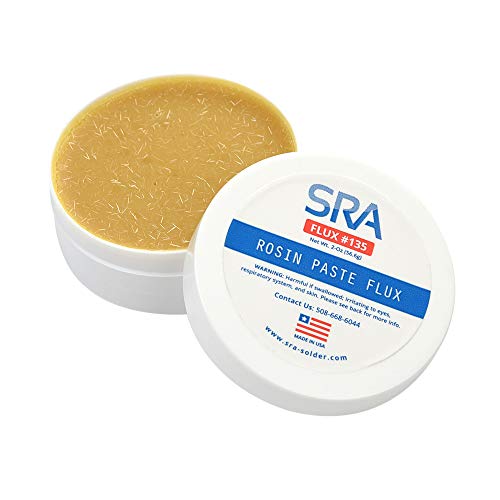
1. SRA Solder 135 Rosin Paste Flux, 2 oz Jar
- Evidence level: candidate — the Amazon US listing is indexed with matching name, part number and composition details, but the live product page could not be read directly during research because Amazon returned an access block, so stock and the featured offer still need a live check before publishing or purchase.
SRA Soldering Products has made fluxes in the United States for decades, and the 135 paste is its general electronics rosin flux. The listing describes an amber, petrolatum-based paste containing rosin with an organic acid activator, sold in a 2 ounce jar under part number FLS135, formulated for both leaded and lead-free solder and for circuit boards and copper electrical wire, with residues described as safe to leave in place. That combination is exactly what tab and wire work needs: a paste thick enough to stay where you put it on a nickel tab or a stranded wire end, active enough to wet nickel-plated surfaces that plain solder struggles with, and mild enough that the residue is not an ongoing corrosion problem.
Paste in a jar suits battery-adjacent joints better than liquid flux for a practical reason. A tab joint should be finished fast, and a small dab of paste placed with a toothpick or a flux brush stays on the tab instead of running down toward the cell. You tin the wire first, away from any cell, place a thin film of paste on the far end of the factory tab, and bring the two tinned surfaces together with the iron for the shortest contact that produces a fully wetted joint. The paste does the cleaning work in that brief window, which is what makes a short contact time possible at all.
Choose the SRA 135 if you want one proven electronics rosin paste for tabs, wires, holders and boards. Skip it if your work is mostly fine-pitch surface-mount rework, where a syringe or pen gives finer control than a jar, and never treat its presence as permission to solder onto a bare cell terminal: the correct use of this paste still keeps the iron off the cell itself, on the tab or the wire.
2. Romeda Rosin Soldering Flux Paste, 2 Jars
- Evidence level: candidate — the Amazon US listing is indexed with matching rosin paste description, ingredients and jar sizes, but the live product page could not be read directly during research, so current availability still needs a live check.
This listing sells two jars of rosin soldering flux paste, each listed at 1.2 ounces or 35 grams, described for lead-free electronics soldering and DIY work, with the rosin content stated in the listing ingredients at roughly forty to fifty percent alongside synthetic resin. Two smaller jars are a sensible format for battery work, because flux paste slowly dries and picks up contamination at the bench. One jar can live with the pack-building tools while the second stays sealed in a kit, and a contaminated jar that has collected metal filings and dust near battery work is cheap to retire rather than worth scraping clean.
The working character of this paste is similar to the SRA above: it sits on the joint, activates as it heats, and helps solder wet nickel tab material and copper wire quickly. Note that lead-free alloys, which this listing targets, melt higher and wet more reluctantly than tin-lead, so joint time runs longer and more heat travels toward a cell. For tab work, many builders therefore prefer tin-lead rosin core wire, and keep a paste like this for wires, holders and boards.
Choose this two-jar paste when you want an inexpensive rosin paste in a split format and your joints are mainly wires, holders and boards. Skip it if you need documented flux classification for production work, because a branded flux with a published specification, such as the SRA above, gives you paperwork this listing does not, and confirm on the listing that the current version is still described for electronics before ordering.
3. Kester 44 Solder Wire, 63/37, 0.031 in, 1 oz Tube
- Evidence level: candidate — the Amazon US listing is indexed with matching alloy, diameter and rosin core description, but the live product page could not be read directly during research, so current availability still needs a live check.
Not every rosin purchase is a separate flux. Kester 44 is a solder wire with the rosin flux already inside it, and for many battery-adjacent joints it is the most controlled way to deliver exactly enough flux and no more. This tube is listed as a 63/37 tin-lead alloy, which is eutectic, meaning it passes from solid to liquid at a single temperature of about 183 degrees Celsius rather than through a pasty range, with a rosin mildly activated core and a wire diameter of 0.031 inches, about 0.8 millimetres. Kester is a long-established solder maker, and the 44 core is one of the most widely used electronics fluxes in wire form.
That profile suits tab and wire joints well. The eutectic alloy freezes cleanly, so a joint disturbed as it cools is less likely to end up weak. The 0.031 inch diameter matches small joints, so you are less likely to flood a tab with excess solder that then needs a long reheat. And the flux arrives fresh, in proportion to the solder fed. For tinning wire ends and holder leads, where most soldering in a battery project actually happens, this wire can be the only flux you need.
Choose Kester 44 in this size when you solder wires, holders and board pads regularly and want a documented, repeatable wire. Skip the tin-lead alloy entirely if your project or your workplace requires lead-free assembly, wash your hands after handling leaded solder and work with ventilation as the safety section describes, and remember that rosin core wire still does not make soldering directly onto a cell acceptable: use it on tabs, wires and boards, with the cell itself kept out of the iron path.
4. Plusivo Solder Wire and Rosin Paste Flux Kit
- Evidence level: candidate — the Amazon US listing is indexed with matching kit contents, wire size and alloy, but the live product page could not be read directly during research, so current availability still needs a live check.
The Plusivo kit bundles the two rosin forms this guide covers into one starter box: a spool of 60/40 tin-lead rosin core solder wire listed at 100 grams and 1.0 millimetre diameter, a container of rosin paste flux, and small accessories including mini screwdrivers and stranded connecting wires. For a reader setting up a bench specifically to wire holders, connect a charging board and finish a small pack project, a bundle like this removes the guesswork of matching a wire and a paste bought separately, and the included hookup wire matches the scale of the joints involved.
The 60/40 alloy melts over a small range rather than at one temperature, which makes it slightly more forgiving to feed and slightly less clean to freeze if the joint moves. The 1.0 millimetre diameter suits wire-to-wire and holder joints better than small board pads, and the paste covers joints where wire flux alone is not enough, such as a holder contact or a tinned wire meeting a tab end.
Choose this kit when you are starting from an empty bench and your joints are wires, holders and larger pads. Skip it if you already own good wire and only need flux, where the SRA paste alone is the tighter purchase, and skip it for fine board work, where a thinner wire gives better control. As with every pick here, the kit is for the wiring around a pack, not for attaching anything directly to a bare cell with an iron.
Safety: soldering around lithium batteries, done correctly
This section is the most important part of the guide, and it states the technique plainly so there is no ambiguity to carry to the bench.
Never solder directly onto a lithium cell. Cell makers prohibit it in their specifications, and the reason is physical, not bureaucratic. A soldering iron tip runs at several hundred degrees, the steel can of a cylindrical cell is thin, and behind that can sit a separator and electrolyte that degrade with heat. A cell can be damaged internally by a joint that looks perfect from outside, and that damage may only show itself later, in use or on charge. Rosin flux improves wetting. It does not reduce the heat that reaches the inside of the cell, so it does not change this rule.
Use the connection method that keeps heat off the cell. Spot welding is the standard way to join cells with nickel strip, because the weld pulse is extremely brief. Cells with factory-welded tabs move the soldering point away from the can, and spring holders remove heat from the process entirely, because you solder the holder wires with no cell fitted. A ready-made protected pack removes the question altogether. Pick one of those routes for anything that joins cells together.
When you solder a factory tab, treat time as the safety limit. Tin the wire first, away from the cell. Apply a thin film of rosin paste to the far end of the tab, as far from the cell body as the tab allows, and use a powerful iron with a broad tip so the joint wets in about two to three seconds rather than a weak iron that must dwell for ten. Let the cell cool fully before any second joint near it, and stop if the cell feels warm. If a joint does not wet quickly, remove the iron, let everything cool, clean and re-flux, and try again with brief contact rather than holding the iron in place and hoping.
Protect the cell and yourself while you work. Remove cells from holders before soldering the holder. Keep the positive terminal insulated whenever a pack is open, because a dropped tool across terminals can short the pack. Work on a non-flammable surface, with no loose metal objects near the work, and never leave a hot iron or a partly built pack unattended. Ventilate the bench, because flux fumes are an irritant, keep leaded solder and hands apart from food, and wash your hands after the session. Wear eye protection whenever you apply heat near any battery.
Know the stop conditions. Do not solder, weld or charge a cell or pack that is swollen, dented, punctured, leaking, unusually hot, or giving off a sweet chemical smell. Isolate it on a non-flammable surface away from other batteries and take it to a battery recycling point. Do not try to rescue it with flux, solder or a charger.
Finally, use only the right flux family. Rosin, rosin mildly activated and electronics no-clean fluxes are the acceptable types for this work. Acid and plumbing fluxes are prohibited for battery and electronics joints, because their active residues continue corroding metal after the joint cools. Check the label of anything already on your bench before you use it near a pack: if it mentions plumbing, pipes or acid, it stays away from batteries.
How to choose between paste, core wire and a kit
Choose a paste when the joint needs help beyond wire flux: nickel tab material, an oxidised holder contact, or a wire to be tinned first. Paste stays exactly on the problem surface while you position the parts. Choose rosin core wire as your default for ordinary joints, because it meters flux automatically. Choose a kit only when equipping a bench from scratch, and check its wire diameter against your joints, because heavy wire on small pads creates problems.
Whatever form you choose, check three things before ordering. The flux must be described for electrical or electronics work. The alloy must match your requirement: tin-lead for ease and low temperature where lead is acceptable, or lead-free where required, accepting that lead-free needs more heat. And the size must suit your joint rate, because a small jar or tube stays fresher than a large container opened for years.
Frequently asked questions
Can I solder wires straight onto an 18650 cell if I am quick?
No. Quick technique reduces heat, but it does not make a prohibited joint safe, and the internal damage heat causes may not be visible afterwards. Use cells with factory-welded tabs and solder to the far end of the tab, use a holder, use a spot welder, or buy a ready-made pack.
Why does solder refuse to stick to a nickel tab?
Because the tab surface is oxidised and nickel-plated surfaces wet reluctantly, especially with a weak iron that never gets the joint properly hot. Rosin flux cleans the surface as it heats, and a powerful iron with a broad tip delivers heat fast enough to wet the joint in seconds. Light surface preparation, fresh flux and adequate iron power solve most sticking problems without longer contact time.
Can I use the flux from a plumbing kit in an emergency?
No. Plumbing and acid fluxes leave corrosive residues that keep attacking the joint, and on a battery connection that corrosion becomes resistance and heat. Wait until you have an electronics rosin or no-clean flux.









