
Our Short List of 3
All 4 Picks at a Glance
| Product | Specs | Action |
|---|---|---|
 1. Renogy Deep Cycle AGM 12V 100Ah — Best Overall | Check price on Amazon | |
 2. WEIZE Deep Cycle AGM 12V 100Ah — Group 31 Alternative | Check price on Amazon | |
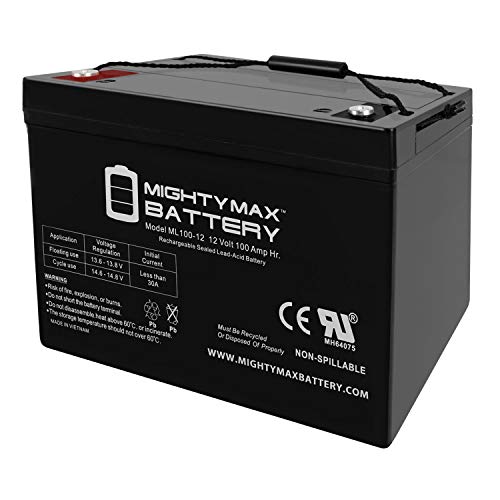 3. Mighty Max ML100-12 — Best for a Group 27 Tray | Check price on Amazon | |
 4. Interstate DCM0100 110Ah — Most Capacity | Check price on Amazon |
Key takeaways
- AGML most likely means an AGM battery. Compare four proven 12V AGM deep-cycle batteries from Renogy, WEIZE, Mighty Max and Interstate by capacity, group size and charging.
As an Amazon Associate we earn from qualifying purchases.
Affiliate Disclosure: This article contains affiliate links. If you buy through a link on this page, we may earn a commission at no extra cost to you. Product specifications are taken from the manufacturers’ and sellers’ product listings, and we have not personally tested these batteries.
First, an honest explanation of the search term itself, because it shapes everything in this guide. There is no recognised battery type, chemistry, or industry standard called AGML. Battery catalogues list flooded lead-acid, AGM, gel, and lithium chemistries, and no major manufacturer sells a battery labelled AGML. The most likely explanation is that AGML is a typing slip or an extra letter added to AGM, the absorbed glass mat battery that most buyers searching this term are actually looking for. A secondary possibility is that the L was carried over from a related term, such as an AGM battery described alongside a size or terminal letter, but no standard product line uses AGML as its name.
So this guide is written about AGM batteries in general, and that is the stated limit of its interpretation: every pick below is a genuine AGM battery, and if you arrived here looking for a specific product literally branded AGML, it does not appear to exist as a standard catalogue item, and you should check the exact name on the battery or equipment you are replacing. What follows will still be useful to almost everyone who typed the term, because the buying decisions for an AGM battery, its capacity, its physical group size, its terminals, and its charging requirements, are the decisions that decide whether the battery you order actually fits and lasts.
All four picks are 12 volt AGM deep-cycle batteries in the 100 amp-hour class, the most common AGM size for RV house banks, solar storage, marine house power, trolling motors, cabins, and backup power. They are the same type of product, sealed absorbed glass mat lead-acid batteries, differing in capacity, case size, terminals, and maker support. That sameness is deliberate: an AGM buying guide should compare like with like, not pad the list with a starter battery, a gel battery, or a lithium battery and call the mixture choice.
Quick Comparison
| Pick | Capacity | Case | Max discharge | Best for |
|---|---|---|---|---|
| Renogy Deep Cycle AGM 12V 100Ah (B075RFXHYK) | 100Ah | 13.1 x 6.9 x 8.6 in | 1100A for 5 seconds | Best overall AGM house battery |
| WEIZE Deep Cycle AGM 12V 100Ah (B0BGKHQQTP) | 100Ah | Group 31, 12.99 x 6.73 x 8.43 in | 1150A | Same capacity in a Group 31 case |
| Mighty Max ML100-12 (B00S1QCK94) | 100Ah | Group 27, 12.09 x 6.65 x 8.48 in | Not published in the listing | Smaller Group 27 tray |
| Interstate DCM0100 (B00YB26RYG) | 110Ah | Group 29, 12.99 x 6.81 x 8.35 in | 1200A for 5 seconds | Most capacity |
Evidence note: every ASIN in this guide is rated candidate, not verified. Amazon US returned an access block when its pages were re-opened during research, so the codes and specifications below come from indexed Amazon US listings and from roundups that cite those listings and maker pages. The codes are real published ASINs for these exact models, but stock and the current featured offer must be confirmed on the live page before purchase, and one pick in this category, the Renogy, has previously been reported with a no-featured-offer warning in our own earlier research, which is why it is first in the live-check list in the notes for this article.
1. Renogy Deep Cycle AGM 12V 100Ah — Best Overall
The Renogy is the default recommendation in the 100Ah AGM class, and the listing explains why. It is a 12 volt, 100 amp-hour deep-cycle AGM battery with a maximum discharge current of 1100 amps for five seconds, a monthly self-discharge rate below 3 percent at room temperature, and a sealed, maintenance-free design that never needs water. Renogy states that more than 230,000 of its AGM batteries have been sold worldwide over six years, which matters in a category full of no-name cases, because a widely sold battery has widely available documentation, and its published figures can be checked against a large base of owner experience.
Its published cycle figure is the most useful number in this guide: 500 cycles at 50 percent depth of discharge, per the maker’s pages. Read that correctly and it tells you how to treat every battery here. An AGM deep-cycle battery that is routinely drained to half and recharged promptly can deliver hundreds of cycles; the same battery drained flat and left sitting will die young regardless of brand. Renogy also publishes the charging figures a solar or RV owner actually needs: a cycle charge voltage of about 14.4 to 14.8 volts, a float voltage of about 13.5 to 13.8 volts, and a maximum charge current of 30 amps. The battery measures 13.1 by 6.9 by 8.6 inches, weighs 63.9 pounds, uses M8 terminal bolts, and supports series connections without a stated limit and parallel connections up to four batteries. Its maker warranty is listed as a two-year prorated material and workmanship warranty.
Choose the Renogy if you want the best-documented 100Ah AGM for an RV, solar bank, cabin, or marine house system, and you value published cycle and charging data over a headline capacity claim. Its weaknesses are the shared weaknesses of the class: it is heavy, it must be installed upright per the maker’s guidance, and, specific to this listing, its live offer status needs the pre-purchase check described above.
2. WEIZE Deep Cycle AGM 12V 100Ah — Group 31 Alternative
The WEIZE offers the same headline capacity as the Renogy, 12 volts and 100 amp-hours, in a Group 31 case measuring 12.99 by 6.73 by 8.43 inches and weighing about 57 pounds per the listing data. Its maximum discharge current is listed at 1150 amps, slightly above the Renogy figure, and its self-discharge rate is listed at 3 percent, with some listing text giving a range of 1 to 3 percent per month. The listing states the terminal arrangement plainly, positive on the left and negative on the right, which is a small detail that prevents a real problem: in a tight battery box, terminal orientation decides whether your existing cables reach without strain or crossing.
WEIZE describes the battery as maintenance-free, with AGM construction that holds the electrolyte in glass mat separators and helps prevent acid leakage, and it is listed for RV, solar, trolling motor, wind, marine, camping, and off-grid systems. The listed operating ranges are about 14 to 122 degrees Fahrenheit for charging and 5 to 122 degrees for discharging, with room temperature given as the preferred operating point. The listing warranty is one year, shorter than the Renogy’s prorated two-year cover, and the supplied specifications do not give a cranking rating, so this should be bought as a deep-cycle house battery, not as an engine-starting battery.
Choose the WEIZE if your battery tray is a Group 31 tray, if its terminal orientation matches your cabling, or if it is the 100Ah AGM you can actually get with a live offer on the day you order. Confirm the group size against your tray before buying, because a Group 31 case will not drop into every space a differently shaped 100Ah battery came out of, even at the same capacity.
3. Mighty Max ML100-12 — Best for a Group 27 Tray
The Mighty Max ML100-12 makes its case on size. It is a 12 volt, 100 amp-hour sealed lead-acid AGM battery in a Group 27 case measuring 12.09 by 6.65 by 8.48 inches, noticeably shorter in length than the Group 31 and Group 29 batteries in this guide. For an RV, boat, or solar cabinet built around a Group 27 tray, that smaller footprint is not a compromise; it is the difference between a battery that fits and one that does not. The listing describes a UL-certified, spill-proof, maintenance-free battery with internal thread terminals, a heavy-duty calcium-alloy grid, and deep discharge recovery, supplied with screws and without a wire harness or mounting accessories.
Mighty Max is explicit in its own listing material that the ML100-12 is not designed as a starting battery, and that honesty is useful. This is a house and storage battery: solar arrays, backup banks, sump pump backup, trolling motors, and RV house power. Roundups list a one-year warranty for the model, while the maker’s own listing material has also been described as not publishing a clear warranty figure, so treat warranty cover as a point to confirm on the live page rather than a reason to buy. The listing also does not publish a maximum discharge figure comparable to the Renogy, WEIZE, and Interstate numbers, which is why the comparison table above says so instead of filling the gap with a guess.
Choose the Mighty Max if your tray is Group 27, if you are building a backup bank where its long listing history in solar and off-grid use is relevant, or if you need a second 100Ah battery that matches an existing ML100-12 already in service, since matching model, age, and capacity is the correct way to expand a lead-acid bank. Do not choose it to start an engine.
4. Interstate DCM0100 110Ah — Most Capacity
If runtime is the whole argument, the Interstate DCM0100 is the pick, because it is the only battery in this guide rated above 100 amp-hours: 110 amp-hours at the 20-hour rate, in a Group 29 case measuring 12.99 by 6.81 by 8.35 inches. Ten extra amp-hours is not a rounding error in a house bank; at the sensible half-discharge working limit for AGM, it is roughly five extra usable amp-hours from every cycle, which is an evening of lights, a water pump’s worth of starts, or a meaningful margin on a fridge running overnight. The maker specification lists a maximum discharge of 1200 amps for five seconds, the highest figure here, and insert terminals with bolts. Its listed warranty is a 12-month performance warranty.
The DCM0100 was developed for deep-cycle and mobility duty, including wheelchairs and scooters as well as solar, wind, RV, and trolling motor applications, so it is built for regular discharge work rather than occasional standby use. Published weights for this model vary between sources, so check the live listing rather than any single roundup figure, and note that batteries in this class are commonly non-returnable online because of hazardous-goods transport rules, which makes measuring your tray before ordering genuinely important.
Choose the Interstate if your tray accepts its Group 29 footprint and you want the longest runtime a single battery in this guide can give. Choose a 100Ah pick instead if your tray, cables, or existing bank are built around a 100Ah battery, because mixing capacities in one bank ages the whole bank at the rate of its weakest member.
Buying Guide: How to Choose an AGM Battery
Understand what AGM is. Absorbed glass mat batteries hold their electrolyte in fibreglass separators pressed between the plates, instead of flooding the plates with free liquid acid. That makes an AGM battery sealed, spill-resistant, maintenance-free in the sense that it never needs topping up, and better able to handle vibration than a flooded battery. It is still a lead-acid battery: heavy, happiest when kept charged, and damaged by being left discharged. AGM is not gel, which uses a thickened electrolyte and different charging limits, and it is not lithium, which is lighter and longer-lived with different charger requirements. If your equipment or charger specifies AGM, buy AGM, which is what every pick here is.
Capacity is rated at a discharge rate. Amp-hour figures for this class are quoted at the 20-hour rate, meaning the capacity delivered when discharged steadily over twenty hours. Draw power faster and you get less usable capacity. For planning, use about half the rated capacity in normal service, so a 100Ah battery is, in daily practice, about 50 usable amp-hours, and the 110Ah Interstate is about 55. Size your bank from that honest figure, not from the number on the case.
Group size is physical, not electrical. Group 27, 29, and 31 describe case dimensions and terminal layout, not quality or capacity. Measure your tray, including height clearance and cable reach, and check terminal type and orientation before ordering.
Charging decides lifespan. Use a charger or charge controller with an AGM profile, respect the maker’s voltage figures, for the Renogy those are roughly 14.4 to 14.8 volts for cycle charging and 13.5 to 13.8 volts on float, and recharge promptly after use rather than storing the battery discharged. The low monthly self-discharge of AGM, around 3 percent or less for the picks here, helps in storage, but it does not make a battery fit to abandon for a year. Heat shortens lead-acid life, so ventilate the battery space.
Do not mix batteries in a bank. Series and parallel banks should use the same model, capacity, and age. The Renogy listing supports series connections and up to four batteries in parallel, but that assumes matched units. Adding one new battery to an old bank makes the bank behave like its weakest member and shortens the new battery’s life.
Know what AGM is not for. Deep-cycle AGM batteries like these are not engine-starting batteries unless the maker gives a cranking rating, and two picks here, the WEIZE and the Mighty Max, are explicit or silent in ways that should steer you away from starting duty. If you need one battery to start an engine and run house loads, look for a dual-purpose AGM with a published cranking figure instead of assuming a deep-cycle battery will do both jobs well.
Frequently Asked Questions
What is an AGML battery? As far as any catalogue, standard, or manufacturer range shows, there is no such product type. AGML is treated in this guide as a mis-typing of AGM, absorbed glass mat, possibly with an extra letter carried over from a size or terminal description. If a seller or a piece of equipment genuinely specifies AGML, ask them for the full battery specification, because no standard battery is sold under that name.
Is AGM better than flooded lead-acid? For most house, solar, marine, and backup uses, yes: AGM needs no water top-ups, resists spills and vibration, and self-discharges slowly. Flooded batteries can cost less for the same capacity, but they need maintenance and venting. Both die early if left discharged.
How long will a 100Ah AGM battery run my equipment? Work from about 50 usable amp-hours in normal service. Divide that by your average draw in amps to estimate hours: a steady 5 amp load is roughly ten hours, a 10 amp load roughly five. Inverter losses reduce the real figure, so treat the estimate as a ceiling.
Can I replace a flooded battery with an AGM battery? Usually yes, if the group size and terminals match, but check your charger. AGM batteries need an AGM or sealed lead-acid charge profile; a charger that equalises at high voltage for flooded batteries can damage one. Set the profile before the first charge.
Can these batteries be mounted on their side? Sealed AGM construction is spill-resistant and some models permit flexible mounting, but makers differ, and at least one pick here, the Renogy, carries upright-installation guidance. Follow the individual maker’s instruction for the model you buy rather than a general rule about AGM.
Verdict
Read as an AGM guide, which is the interpretation this article states openly, the Renogy 100Ah is the best overall pick for its published cycle life, charging data, and documentation, subject to confirming a live offer on its listing. The WEIZE matches its capacity in a Group 31 case with clearly stated terminal orientation, the Mighty Max ML100-12 is the right shape for a Group 27 tray and backup banks, and the Interstate DCM0100 gives the most capacity at 110 amp-hours for trays that accept it. Measure your tray, set your charger to an AGM profile, plan on half the rated capacity as your working budget, and confirm stock on the live listing before you order, because every ASIN here is a candidate pending that live check.









