Our Short List of 3
All 4 Picks at a Glance
| Product | Specs | Action |
|---|---|---|
 SENIX 21-Inch 144cc 3-in-1 Push Mower (ASIN: B0GQ3JWPFY) | Check price on Amazon | |
 BILT HARD 21-Inch 201cc Push Mower (ASIN: B0F89VZXCF) | Check price on Amazon | |
 AMERISUN 21-Inch 3IN1 Push Gas Lawn Mower (ASIN: B0GHRB7SKD) | Check price on Amazon | |
 SENIX 21-Inch 144cc 2-in-1 Push Mower (LSPG-L6) (ASIN: B0GXF1BK9X) | Check price on Amazon |
Key takeaways
- Compare the best push gas mowers with mulching modes: 3-in-1 and 2-in-1 decks, 144cc to 201cc engines, cutting heights and bag sizes for each mower pick.
Disclosure: As an Amazon Associate, we may earn from qualifying purchases made through links on this page, at no additional cost to you.
A push gas mower with a real mulching mode does two jobs at once: it cuts the lawn and feeds it. Instead of raking or bagging every pass, a mulching setup seals the deck, keeps clippings circulating under it, and chops them fine enough to fall back into the turf where they break down and return nitrogen to the soil. For homeowners with small to medium lawns who want gas power without the weight and cost of a drive system, a manual push mower with mulching is the simplest version of that idea.
Every mower in this guide is a true walk-behind push model — no self-propulsion, no battery, no cord — powered by a gasoline engine and equipped with a mulching mode confirmed on its product listing, either as a full 3-in-1 deck (mulch, bag, side discharge) or a 2-in-1 deck (mulch and side discharge) with a mulch plug. The picks span 144cc engines for flat suburban lots up to a 201cc engine for thicker growth, and all four use 21-inch steel decks.
Quick Picks
- Best all-round 3-in-1: SENIX 21-Inch 144cc 3-in-1 Push Mower — full mulch/bag/discharge deck, oil pre-filled, tall rear wheels.
- Best for thick grass: BILT HARD 21-Inch 201cc Push Mower — the largest engine here, with 9.0 ft-lb of stated torque.
- Best for tall cutting heights: AMERISUN 21-Inch 3IN1 Push Gas Lawn Mower — 3-in-1 deck with a height range topping out at 3.9 inches.
- Best lightweight mulch-first pick: SENIX 21-Inch 144cc 2-in-1 Push Mower (LSPG-L6) — a 50-pound mulch-and-discharge mower with no bag to store.
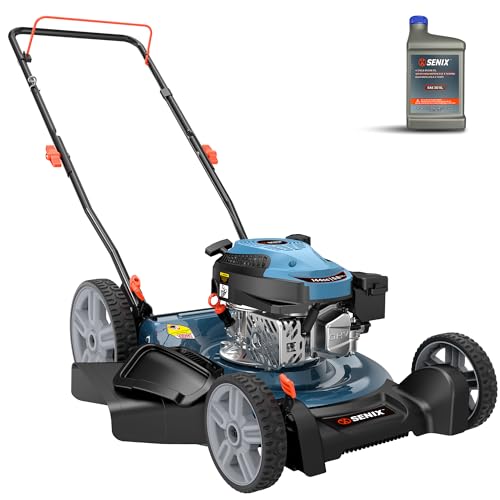
SENIX 21-Inch 144cc 3-in-1 Push Mower (ASIN: B0GQ3JWPFY)
The SENIX 21-inch is built around a 144cc 4-stroke OHV gasoline engine rated at 3.4 HP with 5.8 ft-lb of torque. It is a manual push mower — the listing’s drive type is push and the operation mode is manual — so all forward motion comes from you. The engine ships pre-filled with oil, the fuel tank holds 27 ounces, and the cutting deck is a 21-inch steel dome designed to keep clippings suspended long enough for the blade to re-cut them. At 54.2 pounds it is light for a 21-inch gas mower, which matters on a machine with no drive assist.
Mulching is a core function rather than an accessory: the listing specifies a 3-in-1 mowing function covering mulching, rear bagging and side discharge, and the box includes a mulch plug, a side discharge chute and a 1.7-bushel rear grass bag, so you can switch modes without buying anything else. Cutting height adjusts across six positions from 1.25 to 3.75 inches with a dual-lever system, and the wheel set pairs 8-inch front wheels with 11-inch rear wheels for easier rolling over uneven patches. SENIX backs the mower with a 2-year limited warranty.
Highlights
– True 3-in-1 deck: mulching, rear bagging and side discharge all confirmed on the listing
– Mulch plug, side chute and 1.7-bushel bag included in the box
– Engine arrives pre-filled with oil; 54.2-pound weight is easy to push and store
– 11-inch rear wheels help it roll over ruts and rough edges
Considerations
– Push drive only, so slopes and large lots mean real physical work
– The 1.7-bushel bag fills quickly on bigger lawns if you bag instead of mulch
– Uses SENIX’s own 144cc engine rather than a big-name engine brand
BILT HARD 21-Inch 201cc Push Mower (ASIN: B0F89VZXCF)
Where the 144cc mowers are aimed at routine weekly cuts, the BILT HARD is the power pick of this group. Its 201cc 4-stroke OHV engine is the largest displacement here and is rated at 9.0 ft-lb of torque, which is the figure that matters when a push mower meets tall, dense or slightly neglected grass. It is still a pure push mower with no drive system, and the starting setup is a no-choke, no-primer design intended to make pull starts simpler. The deck is a 21-inch steel unit, and the listed weight is 73.8 pounds — noticeably heavier than the 144cc models, which is the trade you make for the bigger engine.
The deck runs a 3-in-1 clipping system with mulching, side discharge and rear bagging, so mulching is available alongside collection for the weeks when growth gets ahead of you. Height adjustment is handled by a single lever linked to all four wheels, with a range from 1.2 to 3.75 inches — the lowest starting height in this guide, useful for a close cut before overseeding. Wheels are 8-inch front and 9.5-inch rear with double ball bearings for smoother rolling. The maker notes the mower is not designed for hilly terrain or slopes over 15 degrees, which is worth taking seriously on a heavy, unpowered machine.
Highlights
– 201cc engine with 9.0 ft-lb of stated torque — the strongest push-mower power here
– 3-in-1 deck with mulching, side discharge and rear bagging
– Single-lever height adjustment from 1.2 to 3.75 inches across all four wheels
– Double ball-bearing wheels roll more smoothly under the extra weight
Considerations
– At 73.8 pounds listed, it is the heaviest mower in this guide to push and lift
– Not intended for slopes over 15 degrees, per the maker
– The bigger engine is overkill for small, flat, weekly-cut lawns
AMERISUN 21-Inch 3IN1 Push Gas Lawn Mower (ASIN: B0GHRB7SKD)
The AMERISUN 21-inch (model AV8621P1) pairs a 144cc 4-stroke OHV gasoline engine with a 21-inch steel deck in a manual push layout. Starting is handled by a recoil starter with auto choke, which removes the priming and choke steps that frustrate first-time gas mower owners. Like the SENIX 3-in-1 above, it covers the standard residential brief: a mid-size steel-deck mower for small to medium yards where the owner wants clipping options rather than a drive system.
Its 3-in-1 cutting system is stated plainly in the listing title and details: mulching, bagging and side discharge, with a 1.4-bushel grass catcher for the bagging mode. The six-position height adjustment runs from 1.5 to 3.9 inches — the tallest maximum in this group, which suits tall fescue and other grasses that are healthier kept long, especially through summer heat. If your lawn routine alternates between mulching in normal weeks and bagging during heavy spring growth, this mower covers both without a separate mulching kit.
Highlights
– 3-in-1 deck with mulching, bagging and side discharge confirmed on the listing
– Six cutting heights up to 3.9 inches — the highest top setting here
– Auto choke and recoil starter simplify cold starts
– 1.4-bushel catcher included for bagging weeks
Considerations
– The 1.4-bushel bag is the smallest here and needs frequent emptying on larger lawns
– The listing provides fewer secondary details (such as wheel sizes) than its rivals
– Push drive only, as with every mower in this guide
SENIX 21-Inch 144cc 2-in-1 Push Mower (LSPG-L6) (ASIN: B0GXF1BK9X)
The second SENIX in this guide, model LSPG-L6, takes a simpler approach: it drops the bag entirely. Its 144cc 4-cycle gasoline engine runs on straight unleaded fuel with no oil mixing, and it drives a 21-inch steel deck in a manual push chassis that weighs just 50 pounds according to the listing — the lightest mower here. For owners who mulch almost every cut and only occasionally need to throw clippings aside, that simplicity is the point: fewer parts to store, clean and lose.
The 2-in-1 cutting system offers exactly two modes, mulching and side discharge, switched with the mulch plug and chute. Height adjustment is a six-position dual-lever setup spanning 1.25 to 3.75 inches, matching its 3-in-1 sibling, and it rolls on 8-inch front and 11-inch rear wheels, so maneuverability on rough or uneven ground is similar. SENIX covers it with a 2-year limited warranty. What you give up versus the 3-in-1 model is any way to collect clippings — if your municipality, HOA or personal preference requires bagging at times, this is the wrong pick.
Highlights
– Lightest mower in this guide at 50 pounds listed
– Mulching and side discharge with a simple plug-and-chute swap
– Six dual-lever cutting heights from 1.25 to 3.75 inches
– 2-year limited warranty, matching the 3-in-1 SENIX
Considerations
– No bagging mode at all — clippings are mulched or discharged, never collected
– Mulching very tall or wet grass can leave clumps, and there is no bag to fall back on
– Same 144cc power class as the other budget picks; not a thick-grass specialist
How to Choose
Start with the mulching hardware. A mulching mode is only real if the mower includes a mulch plug (or a discharge cover) that seals the deck so clippings recirculate and get re-cut. All four mowers here include that hardware; if you shop beyond this list, confirm the plug is in the box rather than sold separately, and check whether the blade is a mulching-profile blade designed to create lift and re-cut clippings.
Decide whether you need a bag. A 3-in-1 deck (mulch, bag, side discharge) is the flexible choice: mulch in normal weeks, bag during spring flushes or leaf season, side-discharge when the grass is too tall to mulch cleanly. A 2-in-1 mower like the SENIX LSPG-L6 is lighter and cheaper to maintain but commits you to leaving clippings on the lawn every single cut.
Match engine size to your grass, not your ego. A 144cc 4-stroke is enough for flat lots up to roughly a third of an acre with weekly cutting. Step up to the 201cc BILT HARD if your grass grows thick, you often miss a week, or your lot has gentle rises where a push mower needs torque in reserve. Remember that on a push mower you supply the forward force, so a heavier, more powerful mower is also more work to move.
Check the height range against your grass type. Most lawns are healthiest cut between 2.5 and 3.5 inches. A range like 1.25–3.75 inches covers nearly everything; the AMERISUN’s 3.9-inch top suits tall fescue kept long in summer, while the BILT HARD’s 1.2-inch low end suits a scalping cut before overseeding. Also note how adjustment works: a single lever linked to all four wheels (BILT HARD) is faster, while dual levers (the SENIX models) are still simple but take a moment longer.
Weigh the wheels and the weight. Tall rear wheels — 11 inches on both SENIX models — roll over ruts, roots and uneven edges with less effort, which matters when you are the engine. Total weight matters too: the spread here runs from 50 to about 74 pounds, and you will feel every extra pound on turns, slopes and when lifting the mower into a vehicle.
Key Specifications Explained
3-in-1 vs 2-in-1. These labels describe the clipping paths a deck supports. 3-in-1 means mulching, rear bagging and side discharge. 2-in-1 on the mowers here means mulching and side discharge only. Neither label says anything about cut quality by itself — what matters is that the mulching mode is genuinely supported with a plug and a suitable blade.
Mulch plug. A shaped insert that blocks the discharge opening and seals the deck. With the exit closed, clippings stay under the deck longer, get struck by the blade repeatedly, and fall back as fine particles. Removing the plug and fitting the chute converts the same mower to side discharge.
Engine displacement and torque. Displacement (144cc vs 201cc) is the engine’s size; torque, quoted in ft-lb, is the twisting force that keeps the blade spinning when grass gets dense. For mulching specifically, torque matters because the blade is re-cutting clippings in a sealed deck, which loads the engine more than free discharge does.
Cutting height and positions. The range (for example 1.25–3.75 inches) and the number of stops within it. More positions mean finer control; the range’s top end matters most for summer lawn health, since taller grass shades soil and holds moisture.
Bag capacity. Measured in bushels (1.4 to 1.7 here). A bigger bag means fewer stops to empty, at the cost of more weight hanging off the back of a mower you are pushing.
Setup and Use Tips
- Unbox in order. Fit the handle, then add fuel; on models that do not ship with oil, add the specified oil before the first start and check the level on the dipstick. The SENIX 3-in-1 arrives with oil pre-filled, but verify the level anyway before starting.
- Install the mulch plug before your first mulch cut. The plug seats in the discharge opening; if it is not fully seated, clippings escape in a stream instead of recirculating, and the finish looks streaky.
- Follow the one-third rule. Never remove more than a third of the grass blade in one pass. If the lawn has grown too long, raise the deck, make a first pass, then lower it for a second pass a day or two later — mulching an overgrown lawn in one go is what creates clumps.
- Mow dry grass. Wet clippings stick together, pack the underside of the deck and fall as mats. Morning dew is enough to cause it; wait until the lawn dries.
- Keep the blade sharp. Mulching asks the blade to cut the same clipping several times, so a dull edge tears rather than slices and the residue shows. Inspect the blade each season and sharpen or replace it when edges round over.
- Clean the deck underside after mulching sessions. A sealed mulching deck traps moist clippings against the steel. Scraping it down after use slows rust and keeps airflow — and therefore mulching quality — where it should be.
Common Mistakes to Avoid
- Mulching grass that is far too tall. When clippings volume overwhelms the deck, they drop as clumps that smother the turf. Side-discharge or bag the first recovery cut, then return to mulching.
- Cutting too low. Scalping to the bottom of the height range stresses the lawn and invites weeds. Most of these mowers can go near 1.2 inches; that does not mean your lawn wants to be there.
- Leaving the discharge chute on while “mulching.” Without the plug sealing the deck, you are side-discharging with extra steps. The modes are hardware configurations, not just intentions.
- Storing the mower with old fuel. Gasoline degrades over winter and is the leading cause of spring no-starts. Run the carburetor dry or use a fuel stabilizer at season’s end, per the owner’s manual.
- Pushing a heavy mower up steep slopes. None of these mowers has drive assist, and the BILT HARD’s maker explicitly rules out slopes over 15 degrees. Mow across moderate slopes rather than straight up them, and keep footing secure.
FAQ
Do these mowers mulch as well as a self-propelled model?
Mulching quality depends on the deck, blade and engine torque, not on the drive system. A push mower with a sealed deck, a mulch plug and enough torque mulches the same way a self-propelled one does — the drive only changes how much effort you spend moving it.
What is the difference between a mulch plug and a mulching blade?
The plug seals the deck so clippings recirculate; the blade’s shape creates the lift and repeated cutting that shreds them. Effective mulching needs both working together. The mowers here are sold as mulching-capable systems with the plug included.
Can I add bagging to the 2-in-1 SENIX later?
The LSPG-L6 is built as a mulch-and-discharge mower with no rear bagging setup, so treat bagging as unavailable on that model. If you think you will ever need to collect clippings, choose one of the 3-in-1 mowers instead.
Is 144cc enough for thick grass?
For a maintained lawn cut weekly, yes — that class powers most residential 21-inch push mowers. If your grass is routinely tall or dense, the 201cc BILT HARD’s 9.0 ft-lb of torque gives noticeably more reserve before the blade slows.
How fine does mulching leave the clippings?
Fine enough to disappear into the turf when the one-third rule is followed and the grass is dry. The particles break down quickly and return nutrients, which is the entire point of the mode — visible clumps are a sign the grass was too long or too wet, not that mulching failed.
Final Verdict
For most small to medium lawns, the SENIX 21-Inch 144cc 3-in-1 is the balanced pick: a complete mulching system with plug, bag and chute included, a light 54.2-pound chassis and tall rear wheels. Choose the BILT HARD 201cc if your grass is thick or your cutting schedule is irregular and you want torque in reserve, and accept its extra weight. The AMERISUN 3IN1 suits owners who keep grass tall, thanks to its 3.9-inch top height, while the SENIX LSPG-L6 is the minimalist option for committed mulchers who never bag and want the lightest push mower of the four. All four keep the formula honest — gasoline power, a steel 21-inch deck, your legs for propulsion, and a mulching mode that is actually in the box.