
Our Short List of 3

All 5 Picks at a Glance
| Product | Specs | Action |
|---|---|---|
| Netgear 5-Port Gigabit Ethernet Easy Smart Managed Switch (GS305E) | Check price on Amazon | |
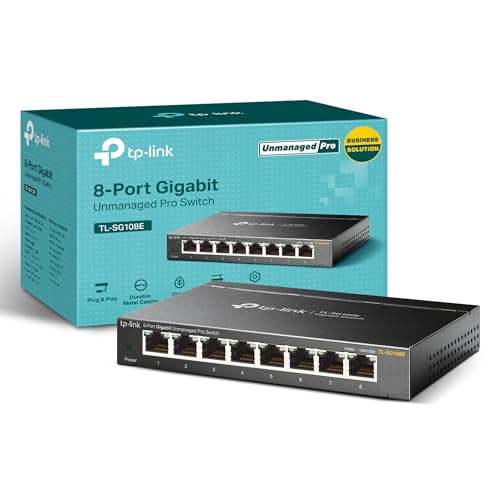 TP-Link 8-Port Gigabit Easy Smart Managed Switch (TL-SG108E) | Check price on Amazon | |
 TP-Link 8-Port Gigabit PoE Easy Smart Managed Switch (TL-SG108PE) | Check price on Amazon | |
 Netgear 8-Port Gigabit Ethernet PoE Plus Easy Smart Switch (GS308EP) | Check price on Amazon | |
 TRENDnet 8-Port Unmanaged 2.5G Switch (TEG-S380) | Check price on Amazon |
Key takeaways
- Five managed, PoE and multi-gigabit network switches compared for home and office use, with port counts, VLAN support, power budgets and setup guidance.
A router with four LAN ports runs out of room quickly once a desktop, a game console, a smart TV, a printer and a NAS all want a wired connection. A network switch adds ports in minutes: one cable from the router to the switch, and every remaining port becomes a wired connection for another device. This guide looks past basic unmanaged boxes to switches that earn their place with management features, power over Ethernet, or faster multi-gigabit ports. The five picks below cover a small managed desk switch, two eight-port smart switches, two PoE models for cameras and access points, and one 2.5G switch for fast local transfers.
As an Amazon Associate, we earn from qualifying purchases.
Quick answer
Start with the Netgear GS305E for a small managed desk setup, or the TP-Link TL-SG108E for eight managed ports. Add the TP-Link TL-SG108PE or Netgear GS308EP when cameras or access points need power over the same cable. Choose the TRENDnet TEG-S380 when several devices already support 2.5G and local transfers matter most.
Netgear 5-Port Gigabit Ethernet Easy Smart Managed Switch (GS305E)
The GS305E is the smallest managed switch in this guide and the right starting point for a desk that needs more than plug-and-play forwarding. Its five gigabit ports run at 10, 100 or 1000 Mbps with auto-negotiation, and the switch delivers 10 Gbps of switching capacity, so all five ports can run at full speed at the same time. Management comes through a web browser interface, with VLAN support for separating work traffic from guest or smart-home traffic, QoS for giving voice and video calls priority, and IGMP snooping for keeping multicast streams such as IPTV from flooding every port. Port mirroring and loop detection are included, along with broadcast storm control and rate limiting for keeping a misbehaving device from dragging the network down. The MAC address table holds 8K entries and the packet buffer is 128KB, with jumbo frame support up to 9KB for large local transfers. The metal case is fanless and silent, and the switch works on a desktop or mounted on a wall. One port connects to the router, leaving four for devices, which suits a single desk or a small media setup.
TP-Link 8-Port Gigabit Easy Smart Managed Switch (TL-SG108E)
The TL-SG108E is the eight-port managed answer for a home office or living room with more wired gear than a five-port switch can serve. All eight ports are gigabit with auto-negotiation, and the switch provides 16 Gbps of switching capacity for full-speed traffic across every port at once. The Easy Smart web interface adds VLAN support, QoS prioritization, IGMP snooping and link aggregation, so two ports can be bonded for a faster link to a NAS or a server where the other end supports it. The ports are shielded, which adds durability in crowded cable runs, and the sturdy metal housing is fanless, so the switch stays silent behind a TV stand or under a desk. Setup is plug and play for basic use, with management available only when it is wanted, which makes this a gentle first step into managed networking. The box includes the switch, a power adapter, an installation guide and rubber feet, and the unit mounts on a desktop or a wall. With one port reserved for the router link, seven remain for devices, enough for a TV, two consoles, a streaming box, a desktop and a printer with room to spare.
TP-Link 8-Port Gigabit PoE Easy Smart Managed Switch (TL-SG108PE)
The TL-SG108PE solves a different problem: devices that need power as well as data, with no spare outlet nearby. Four of its eight gigabit ports supply PoE Plus power, with a total power budget of 64W, which covers ceiling access points, IP cameras, VoIP phones and other PoE devices from a single cable run each. The remaining four ports are standard gigabit ports for ordinary wired devices. Like the TL-SG108E, it is an Easy Smart managed switch, with VLAN support, QoS, IGMP snooping and link aggregation through a web interface, plus plug-and-play operation for anyone who never opens the settings. The metal housing is fanless and the ports are shielded, and the switch works on a desktop or mounted on a wall. One practical note deserves attention: TP-Link published a security advisory for a stored cross-site scripting flaw in the web management interface of the TL-SG108PE V5 hardware, identified as CVE-2026-34127, with a fixed firmware version available, so updating the firmware after installation is worth doing before the switch goes into daily service.
Netgear 8-Port Gigabit Ethernet PoE Plus Easy Smart Switch (GS308EP)
The GS308EP is Netgear’s PoE answer in the same eight-port size, and it powers all eight ports rather than four. Every port is a gigabit PoE Plus port, and the total power budget is 62W, which suits a mix of cameras, access points and VoIP phones spread around a home or small office. As an Easy Smart managed switch it offers VLAN support, QoS, IGMP snooping and port mirroring through a web interface, with the same plug-and-play behaviour as an unmanaged switch for anyone who skips the settings. The metal case is fanless and silent, the footprint is compact at 158 by 101 by 27 mm, and the switch sits on a desktop or mounts on a wall. The model number on the listing is GS308EP-100NAS, which is the North American version. Because every port can deliver power, there is no need to plan which devices sit on PoE ports and which do not, and a camera or access point can move to any free port later without rewiring. The 62W budget is the limit to respect: add up the draw of every powered device before buying, since a set of power-hungry cameras can exceed it even when ports remain free.
TRENDnet 8-Port Unmanaged 2.5G Switch (TEG-S380)
The TEG-S380 is the speed pick of this guide, built for networks where the bottleneck is the gigabit ceiling rather than the port count. All eight ports are 2.5GBASE-T, running at 100 Mbps, 1 Gbps or 2.5 Gbps with auto-negotiation, and the official switching capacity is 40 Gbps, which keeps every port at full speed at once. That matters for transfers between a PC and a NAS, for a 2.5G-capable Wi-Fi access point, and for any desk where large files move locally every day. The switch is unmanaged, so there is no VLAN or QoS configuration, and no PoE, which keeps the focus entirely on raw local speed. The metal enclosure is fanless, the unit is wall mountable, and it works with Cat5e or better cabling, so most existing home wiring needs no replacement. Jumbo frames up to 12KB, a 4K MAC address table and a 1MB RAM buffer round out the specification, with a maximum power draw of 7.26W and a lifetime warranty on metal-enclosed switches bought in the United States and Canada. One caution applies: TRENDnet documents more than one hardware version of this model, and the listing title has shown a different capacity figure than the official specification, so checking the hardware version on the unit label against the support page is sensible after delivery.
How to choose
Count ports first, then add two spares, remembering that one port always goes to the router. Next, decide whether management matters: VLANs separate traffic for work, guests and smart-home gear, while QoS keeps calls smooth when downloads run, and both need a managed or smart-managed switch. PoE is a separate decision, and it turns on the power budget rather than the port count, since every powered device draws from one shared total. For speed, gigabit covers internet sharing, streaming and office work, while 2.5G only pays off between local devices that both support it, such as a NAS and a desktop. Build matters for hardware that runs constantly, so a fanless metal case is the safer choice for a bedroom or living room. Finally, check firmware after installation: older Netgear ProSAFE web-managed models were covered by an authentication-bypass advisory with fixes available, and none of the picks here is a model named in that advisory.
Who should skip
Skip a managed switch if every device simply needs a port and no traffic will ever be separated or prioritized, since an unmanaged switch does the same forwarding job with nothing to configure. Skip PoE models when no camera, access point or phone needs power over Ethernet, because the power circuitry adds cost and a larger power adapter for no benefit. Skip the 2.5G pick when every device on the network is gigabit-only, since the faster ports will simply negotiate down to gigabit speed and the extra capability goes unused. Skip a switch entirely when the real problem is weak Wi-Fi in one room, since a switch cannot create wireless coverage, though it can feed an access point that does.
Frequently asked questions
What is the difference between a managed and an unmanaged switch?
An unmanaged switch forwards traffic between ports with no configuration, which is enough when every device just needs a connection. A managed or smart-managed switch adds a web interface for VLANs, QoS, IGMP snooping and port monitoring, which lets traffic be separated, prioritized and observed. The managed models in this guide still work out of the box without any settings changed, so the extra features stay optional until they are needed.
How many PoE devices can a switch power?
That depends on the total power budget, not the number of PoE ports. A switch with a 62W budget can power several low-draw cameras or access points, but a few power-hungry devices can use the whole budget with ports still free. Add up the draw of every device that will connect, leave headroom for devices that draw more on startup, and choose a switch whose budget covers the total with room to spare.
Do I need new cables for a 2.5G switch?
Usually not. Cat5e cable supports 2.5G at typical home distances, and Cat6 gives more headroom for longer runs. Very old Cat5 cable can limit links to 100 Mbps, and a bad crimp or a damaged run causes more trouble than cable category ever will. When a link negotiates below the expected speed, checking the cable and the terminations is the first step before suspecting the switch.
Can I connect one switch to another switch?
Yes. Switches can be chained, so one cable can run to a room and a second switch there can serve the local devices. Each hop works fine for home use. Avoid connecting two switches with two cables at once, which can create a loop that floods an unmanaged network. A single link between them is all that is needed, and managed switches add loop detection as a safety net.
Final verdict
For most homes, the TP-Link TL-SG108E is the default: eight managed gigabit ports, silent operation and room to grow. The Netgear GS305E is the better fit for a single desk that needs management in a smaller box. Add PoE with the TP-Link TL-SG108PE for four powered ports or the Netgear GS308EP when every port should power a device. The TRENDnet TEG-S380 is the specialist pick, and the right one when fast local transfers between 2.5G devices are the whole point of the upgrade.
Product and ASIN Reference
| Product | ASIN |
|---|---|
| Netgear 5-Port Gigabit Ethernet Easy Smart Managed Switch (GS305E) | B07PJ7XZ7X |
| TP-Link 8-Port Gigabit Easy Smart Managed Switch (TL-SG108E) | B00K4DS5KU |
| TP-Link 8-Port Gigabit PoE Easy Smart Managed Switch (TL-SG108PE) | B01BW0AD1W |
| Netgear 8-Port Gigabit Ethernet PoE Plus Easy Smart Switch (GS308EP) | B08MBFLMDC |
| TRENDnet 8-Port Unmanaged 2.5G Switch (TEG-S380) | B08XWKF55C |









