Key takeaways
- Find the best cost effective wifi range extenders for weak rooms: four dual-band picks compared by coverage, speed class, mesh support and wired ports.
A range extender is the simplest fix for the room where your WiFi fades: the back bedroom where video calls freeze, the home office where uploads crawl, or the corner of the house where a smart TV keeps dropping its connection. Instead of replacing your router or rewiring the house, an extender picks up the existing signal and rebroadcasts it into the weak area. The trade-off is that an extender can only work with the signal it receives, so placement and band choice matter as much as the headline speed on the box.

This guide is for households that want a practical, good-value fix rather than a full network overhaul. The four extenders below were chosen from their Amazon listing names and specifications only, and they cover the main buying paths: a WiFi 5 model with adjustable antennas and a wired port, two WiFi 6 wall-plug models built around mesh-style roaming, and a faster WiFi 6 option for homes that want more headroom. Each one is dual-band, each one works with a standard router, and each one suits a slightly different home.
Quick Picks
Our Short List of 3
- Best for: Budget-conscious households with a WiFi 5 router, one or two weak rooms, and a wired device near the extender.
- Brand: TP-Link
- Model: RE315
- WiFi standard: WiFi 5, 802.11a/b/g/n/ac
- Speed class: AC1200 — 867 Mbps (5 GHz) + 300 Mbps (2.4 GHz)
- Best for: WiFi 6 households that want seamless roaming under a single network name and current WPA3 security.
- Brand: NETGEAR
- Model: EAX15 (EAX15-100NAS)
- WiFi standard: WiFi 6
- Speed class: AX1800 — up to 1.8 Gbps combined

- Best for: Larger homes and long layouts where the dead zone sits well away from the router.
- Brand: Linksys
- Model: RE7350
- WiFi standard: WiFi 6
- Speed class: AX1800 — up to 1.8 Gbps combined
All 4 Picks at a Glance
| Product | Specs | Action |
|---|---|---|
| TP-Link AC1200 WiFi Extender (RE315) |
| Check price on Amazon |
| NETGEAR WiFi 6 Mesh Range Extender (EAX15) |
| Check price on Amazon |
| Linksys RE7350 Dual-Band WiFi 6 Wireless Range Extender |
| Check price on Amazon |
 ASUS RP-AX58 AX3000 Dual Band WiFi 6 Range Extender |
| Check price on Amazon |
How to Choose
Match the WiFi standard to your router
An extender works best when its WiFi standard is in the same generation as your router. A WiFi 5 extender like the TP-Link RE315 pairs naturally with an older AC router and still covers everyday browsing, streaming and video calls well. If your router already runs WiFi 6, a WiFi 6 extender such as the NETGEAR EAX15, Linksys RE7350 or ASUS RP-AX58 keeps the newer standard’s efficiency features in play between router and extender. There is little point paying for a faster extender than your router and internet plan can feed, so let your current router set the ceiling.
Read coverage ratings as a guide, not a promise
Manufacturers rate extenders by the area they add, and the four picks here range from about 1,500 sq ft up to 2,000 sq ft of added coverage. Treat those figures as best-case numbers for open layouts. Thick walls, brick, metal appliances and floors between the router and the extender all shrink real-world reach. If your dead zone is one room away, a 1,500 sq ft class model is usually plenty. If you are trying to push signal across a long floor plan or into a detached-feeling wing of the house, the higher coverage rating of the Linksys RE7350 gives you more margin.
Decide whether you need a wired port
Three of the four picks include an Ethernet port, and it is worth deciding in advance whether you will use it. A wired port lets you plug in a device that sits near the extender — a desktop PC, a game console, a smart TV or a printer — so that device gets a stable cable connection while the extender handles the wireless hop back to the router. The TP-Link RE315 has a Fast Ethernet port, while the ASUS RP-AX58 steps up to a Gigabit Ethernet port, which suits faster wired devices. If everything in the weak room is wireless anyway, a port matters less, but it is rarely a drawback to have one.
Consider mesh features and network naming
Traditional extenders often create a second network name, so your phone may cling to the weak router signal instead of switching. Mesh-style extenders address this with smart roaming under one network name. The NETGEAR EAX15 is built around that idea, the TP-Link RE315 supports OneMesh and EasyMesh systems, and the ASUS RP-AX58 works as an AiMesh node with compatible ASUS routers while still functioning with any brand of router. If you already own, or plan to buy, a router from one of these ecosystems, matching the extender to it gives the smoothest roaming. If not, each of these extenders still works as a standalone repeater.
The 4 Best Options
TP-Link AC1200 WiFi Extender (RE315)
- Best for: Budget-conscious households with a WiFi 5 router, one or two weak rooms, and a wired device near the extender.
- Brand: TP-Link
- Model: RE315
- WiFi standard: WiFi 5, 802.11a/b/g/n/ac
- Speed class: AC1200 — 867 Mbps (5 GHz) + 300 Mbps (2.4 GHz)
Budget-conscious households with a WiFi 5 router, one or two weak rooms, and a wired device near the extender.
It is a WiFi 5 model, so it will not carry WiFi 6 features from a newer router, and the Ethernet port is Fast Ethernet rather than Gigabit.
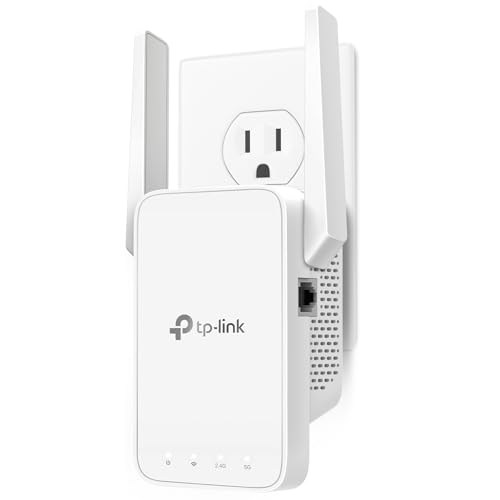
The TP-Link RE315 is the straightforward value pick in this group. It is a dual-band WiFi 5 extender rated at AC1200, with 867 Mbps on the 5 GHz band and 300 Mbps on the 2.4 GHz band, and TP-Link rates it for coverage up to roughly 1,500 to 1,600 sq ft and connections for around 30 to 32 devices. For a household whose problem is one or two weak rooms rather than a whole floor, that is a sensible match of capacity to need.
Two details make it more flexible than many wall-plug extenders. The two external antennas are adjustable, so you can angle them to aim coverage toward the room that needs it, and the Fast Ethernet port gives a nearby wired device a stable connection. Setup runs through the TP-Link Tether app, and the RE315 is compatible with OneMesh and EasyMesh systems if you later move to a mesh router setup.
Watch out for: It is a WiFi 5 model, so it will not carry WiFi 6 features from a newer router, and the Ethernet port is Fast Ethernet rather than Gigabit.
NETGEAR WiFi 6 Mesh Range Extender (EAX15)
- Best for: WiFi 6 households that want seamless roaming under a single network name and current WPA3 security.
- Brand: NETGEAR
- Model: EAX15 (EAX15-100NAS)
- WiFi standard: WiFi 6
- Speed class: AX1800 — up to 1.8 Gbps combined
WiFi 6 households that want seamless roaming under a single network name and current WPA3 security.
Its rated coverage matches the smaller end of this group, and its device rating of 20-plus is lower than the TP-Link’s, so very device-heavy homes should note the difference.
The NETGEAR EAX15 brings WiFi 6 to a compact wall-plug extender. It is an AX1800 dual-band model rated up to 1.8 Gbps combined, and NETGEAR positions it as adding up to 1,500 sq ft of coverage for more than 20 devices. Rather than behaving like an old-style repeater with a separate network name, it is designed as a mesh extender with smart roaming, so your devices move between the router and the extender under one network name.
Security is a quiet strength here: the EAX15 supports WPA3, the current WiFi security standard, which is worth having if your router also supports it. The wall-plug design keeps it off shelves and out of the way, and because it works as a universal extender, it does not lock you into a NETGEAR router. It suits a home that has already moved to WiFi 6 and wants the dead zone fixed without changing how the network appears to everyone using it.
Watch out for: Its rated coverage matches the smaller end of this group, and its device rating of 20-plus is lower than the TP-Link’s, so very device-heavy homes should note the difference.
Linksys RE7350 Dual-Band WiFi 6 Wireless Range Extender
- Best for: Larger homes and long layouts where the dead zone sits well away from the router.
- Brand: Linksys
- Model: RE7350
- WiFi standard: WiFi 6
- Speed class: AX1800 — up to 1.8 Gbps combined
Larger homes and long layouts where the dead zone sits well away from the router.
The listing information is leaner than the others here — it does not headline a wired port or a device count — so buyers who need a cable connection for a nearby device should look at the TP-Link or ASUS instead.
The Linksys RE7350 is the coverage pick. It is an AX1800 dual-band WiFi 6 extender rated up to 1.8 Gbps combined, and the listing rates its coverage at up to 2,000 sq ft — the largest figure in this group. That extra reach makes it the natural candidate when the weak area is far from the router: a far bedroom, a converted garage space, or a home office at the opposite end of the house.
The RE7350 uses a wall-plug design, so installation is a matter of choosing an outlet roughly midway between the router and the dead zone where the router signal is still decent. Its dual-band transmission shares the incoming connection across both bands for the devices it serves. If your layout is the main problem and your router is already WiFi 6, this is the extender in the list built most directly around your situation.
Watch out for: The listing information is leaner than the others here — it does not headline a wired port or a device count — so buyers who need a cable connection for a nearby device should look at the TP-Link or ASUS instead.
ASUS RP-AX58 AX3000 Dual Band WiFi 6 Range Extender
- Best for: Homes with fast internet plans, several active devices in the weak area, or an existing ASUS AiMesh router.
- Brand: ASUS
- Model: RP-AX58
- WiFi standard: WiFi 6, 802.11ax
- Speed class: AX3000 — 2,402 Mbps (5 GHz) + 574 Mbps (2.4 GHz)
Homes with fast internet plans, several active devices in the weak area, or an existing ASUS AiMesh router.
Its extra speed only pays off if your router and internet plan can supply it; on a slow connection it will perform like the cheaper WiFi 6 models here.
The ASUS RP-AX58 is the headroom pick. It is an AX3000 dual-band WiFi 6 extender rated up to 3,000 Mbps in total — 2,402 Mbps on the 5 GHz band and 574 Mbps on the 2.4 GHz band — which is the highest speed class in this group. That capacity suits homes with faster internet plans and several active devices in the extended area, where a slower extender could become the bottleneck.
ASUS builds it to work two ways. As an AiMesh extender, it joins compatible ASUS routers in a seamless mesh system; as a standard range extender, it works with any WiFi router. It includes a Gigabit Ethernet port for a wired device, supports WPA3 security, and offers WPS setup for a quick pairing with the router. The wall-plug design keeps the footprint small despite the higher performance class.
Watch out for: Its extra speed only pays off if your router and internet plan can supply it; on a slow connection it will perform like the cheaper WiFi 6 models here.
Which One Fits Your Situation
One weak bedroom on an older router
Choose the TP-Link RE315. Its WiFi 5 AC1200 capacity matches an older router, the adjustable antennas help aim signal into a single room, and the Ethernet port covers a TV or console sitting nearby.
A WiFi 6 home that hates switching networks
Choose the NETGEAR EAX15. Smart roaming under one network name is its reason to exist, and WPA3 support keeps security current alongside a WiFi 6 router.
A long house with a far-off dead zone
Choose the Linksys RE7350. Its coverage rating of up to 2,000 sq ft is the highest here, which gives the most margin when distance is the core problem.
A busy room on a fast connection
Choose the ASUS RP-AX58. The AX3000 speed class and Gigabit port give the most headroom for several active devices, and AiMesh support is a bonus if your router is an ASUS model.
Common Mistakes
- Placing the extender inside the dead zone itself, where it receives a weak signal and can only rebroadcast that weak signal.
- Putting the extender right next to the router, which adds almost no new coverage.
- Buying a WiFi 6 extender to fix a bottleneck that is actually a slow internet plan or an aging router.
- Forgetting the 2.4 GHz band, which travels farther through walls and is often the band that actually reaches the far room.
- Judging success by signal bars alone instead of checking whether the problem room can hold a call or stream steadily.
Frequently Asked Questions
Will a range extender slow down my connection?
An extender adds an extra wireless hop between your device and the router, so some speed loss is normal compared with standing near the router. In practice, a strong and stable connection in a formerly weak room is far more usable than a faster-on-paper signal that keeps dropping, and dual-band models like these four manage the hop better than older single-band repeaters.
Where should I place the extender?
Start with an outlet roughly halfway between the router and the weak area, where the extender still receives a solid router signal. Too close to the router adds little coverage; too far away leaves the extender repeating a weak signal. Expect to try two or three outlets before settling, and use the adjustable antennas on the TP-Link RE315 to fine-tune direction if you choose that model.
Do I need a new network name for the extender?
It depends on the model and mode. Mesh-style extenders such as the NETGEAR EAX15 use smart roaming under one network name, and the ASUS RP-AX58 does the same inside an AiMesh system. In standard repeater mode, an extender may broadcast a separate network name, which simply means you connect your devices in the far room to that name instead.
Can an extender help with a wired device?
Yes, if it has an Ethernet port. The TP-Link RE315 includes a Fast Ethernet port and the ASUS RP-AX58 includes a Gigabit Ethernet port, so a desktop, console or TV near the extender can connect by cable while the extender handles the wireless link back to the router. This is often the most stable arrangement for a desk setup in a weak room.
Related guides
- Best WiFi 6 routers for home networks
- Mesh WiFi systems vs range extenders: which fix fits your home
- How to fix WiFi dead zones without replacing your router
As an Amazon Associate, we earn from qualifying purchases.