We independently review everything we recommend. When you buy through our links, we may earn a commission. As an Amazon Associate we earn from qualifying purchases.
Best Budget Drone for Beginners: 5 Picks That Fly Easy
Compare five budget drones for beginners, from a pocket mini quadcopter to sub-249-gram GPS flyers, and pick the right first drone for learning to fly.
Compare five budget drones for beginners, from a pocket mini quadcopter to sub-249-gram GPS flyers, and pick the right first drone for learning to fly.
⭐ Key Takeaways
Quick answer: Our top pick is DJI Mini 2 SE, with DJI Mini 4K as a strong alternative.
As an Amazon Associate, we earn from qualifying purchases.
The DJI Mini 2 SE is the best budget drone for beginners overall, because it pairs a three-axis gimbal with a 31-minute maximum flight time, a 10-kilometer maximum transmission range, and a weight under 249 grams in a foldable airframe that is simple to carry and simple to learn. The DJI Mini 4K adds 4K video, and the Potensic ATOM SE is the strongest non-DJI alternative. For the lowest entry point, the Holy Stone HS110D and the DEERC D20 teach stick control with altitude hold, headless mode, and one-key takeoff at a budget tier.
A first drone should forgive mistakes, and that starts with weight. Drones under 249 grams are light enough that recreational flyers in the United States generally do not need FAA registration, and they are easier to carry on a hike or a trip.
GPS positioning is the most useful beginner feature after weight. A GPS drone holds its position in a light breeze, returns to its takeoff point when the signal drops or the battery runs low, and lands where it started instead of drifting away. The DJI and Potensic picks carry GPS, while the Holy Stone HS110D and the DEERC D20 rely on altitude hold instead. If a first flight will happen outdoors in open space, GPS is worth the step up.
Flight time shapes how much practice each outing delivers. A single battery lasting around 20 to 31 minutes is a good baseline, and a kit with two or three batteries turns one short session into a real afternoon of practice. The Potensic ATOM SE Expansion Kit is the standout here, with three batteries for up to 62 minutes of total flight time, while the Holy Stone HS110D and the DEERC D20 each ship with two batteries.
Camera quality should match the goal. A 720p or 1080p camera is enough for learning framing, practicing smooth turns, and sharing casual clips. A 2.7K or 4K camera with a gimbal or electronic stabilization produces noticeably smoother footage, which matters once the basics feel natural. The DJI Mini 2 SE and the DJI Mini 4K both use a three-axis gimbal, which keeps the camera level while the airframe tilts, and the Potensic ATOM SE uses electronic image stabilization for a similar effect.
The DJI Mini 2 SE is the best budget drone for beginners because it combines the core strengths of the DJI Mini line with the simplest learning curve in the range. It weighs less than 249 grams, folds down to a pocket-sized package, and flies for up to 31 minutes on a single battery. The three-axis gimbal keeps 2.7K video steady while the drone moves. OcuSync transmission reaches up to 10 kilometers in open conditions.
Learning to fly the Mini 2 SE is straightforward. The DJI Fly app walks a new pilot through activation and first takeoff, and the drone offers one-button return to home, automatic takeoff and landing, and QuickShots modes that fly preset camera moves with a single tap. It suits a beginner who wants one drone to grow with. Its main limits are the 2.7K ceiling on video and the lack of obstacle sensing.
Specs
Weight: Under 249 g
Camera: 2.7K video at 30 frames per second, 12 MP stills
Gimbal: Three-axis mechanical gimbal
Max flight time: 31 minutes
Max transmission range: 10 km with OcuSync
Wind resistance: Up to 38 kph
Battery: One Intelligent Flight Battery included
Controller: DJI RC-N1 with phone mount
Special features: Auto return to home, QuickShots, panorama modes
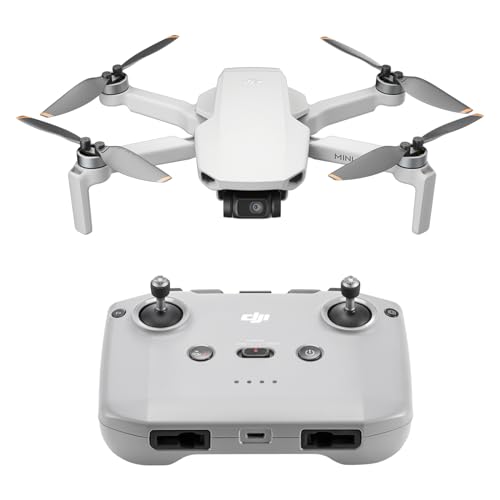
The DJI Mini 4K takes the same beginner-friendly airframe as the Mini 2 SE and upgrades the camera to 4K video, making it the pick for a beginner who cares about footage quality from the first flight. It shares the sub-249-gram weight, the three-axis gimbal, the 31-minute maximum flight time, and the 10-kilometer maximum transmission range,. The difference shows up on screen: 4K video holds more detail when cropped or viewed on a large display.
Everything that makes the Mini 2 SE easy to learn carries over here. The DJI Fly app guides setup and first flights, one-button return to home brings the drone back when the battery runs low or the signal weakens, and QuickShots modes automate cinematic camera moves. The Mini 4K is the right choice when video quality is the priority and the budget stretches to a premium tier. A beginner who only wants to learn stick skills can save money with the Mini 2 SE.
Specs
Weight: Under 249 g
Camera: 4K UHD video, 12 MP stills
Gimbal: Three-axis mechanical gimbal
Max flight time: 31 minutes
Max transmission range: 10 km with OcuSync
Wind resistance: Up to 38 kph
Battery: One Intelligent Flight Battery included
Controller: DJI RC-N1 with phone mount
Special features: Auto return to home, QuickShots, panorama modes
The Potensic ATOM SE Expansion Kit is the best budget drone for beginners who want a DJI alternative with GPS and long total flight time. The ATOM SE itself weighs under 249 grams, carries a 4K camera with electronic image stabilization, and flies for up to 31 minutes per battery. The expansion kit adds a charging hub and extra batteries for three batteries in total, giving up to 62 minutes of combined flight time.
The ATOM SE uses a 12-megapixel Sony CMOS sensor, and its electronic stabilization smooths video without a mechanical gimbal. Transmission reaches up to 4 kilometers, which is shorter than the DJI picks but more than enough for line-of-sight beginner flying. This kit suits a beginner who wants maximum practice time in one purchase: three batteries mean three full flights before recharging, which speeds up learning noticeably.
Specs
Weight: Under 249 g
Camera: 4K video at 30 frames per second, 12 MP stills
Stabilization: Electronic image stabilization
Max flight time: 31 minutes per battery, 62 minutes with three batteries
Max transmission range: 4 km
Motors: Brushless motors
Batteries: Three batteries with charging hub included
Controller: Remote controller with phone mount
Special features: GPS auto return, follow-me, three flight modes
The Holy Stone HS110D is the lowest-cost way to learn the fundamentals of drone flying with a camera. It records 1080p video through a wide-angle lens, streams a live first-person view to a phone over Wi-Fi, and includes two batteries for about 20 minutes of total flight time. Altitude hold keeps the drone at a steady height while a new pilot focuses on direction, headless mode removes the confusion of orientation when the drone turns toward the pilot, and one-key takeoff and landing handle the trickiest moments of each flight.
The HS110D is a brushed-motor drone with a 100-meter control range, which suits backyard and park flying rather than long-distance flights. It will not hold position in wind the way a GPS drone does, and its fixed camera cannot match a gimbal for smooth footage, but those limits are acceptable at a budget tier.
Specs
Weight: 166 g
Camera: 1080p HD video, 120-degree wide-angle lens
Max flight time: About 10 minutes per battery, two batteries included
Control range: Up to 100 m
Motors: Brushed motors
Batteries: Two modular batteries included
Controller: Remote controller with phone mount
Special features: Altitude hold, headless mode, one-key takeoff and landing, voice and gesture control, 3D flips
Tier: Budget
DEERC D20 Mini Drone
The DEERC D20 Mini Drone is the smallest and lightest first quadcopter in this roundup, and it is built for pure practice. At 90 grams, it fits in a pocket and flies indoors or in a calm backyard. The 720p camera streams a live first-person view to a phone, and the drone includes altitude hold, headless mode, one-key start, speed adjustment, and 3D flips. Two batteries give about 20 minutes of total flight time.
Flying the D20 is deliberately simple. One key starts the motors and lifts the drone to a hover, altitude hold keeps it steady while the pilot steers, and headless mode means the controls stay consistent no matter which way the drone faces. The D20 suits a first-time pilot, a younger flyer, or anyone who wants a low-stakes drone for indoor practice. Its 720p camera is basic, its range is short, and it has no GPS, so it is not the pick for outdoor video or windy days.
Specs
Weight: 90 g
Camera: 720p HD video with live first-person view
Max flight time: About 10 minutes per battery, two batteries included
Control range: Short range for indoor and backyard flying
Motors: Brushed motors
Batteries: Two batteries included
Controller: Compact remote controller with phone mount
Special features: Altitude hold, headless mode, one-key start, three speed settings, 3D flips
Tier: Budget
Frequently Asked Questions
What is the best budget drone for a complete beginner?
The DJI Mini 2 SE is the best overall pick for a complete beginner, because it combines GPS, auto return, a three-axis gimbal, and a 31-minute flight time in a sub-249-gram drone.
Do I need to register a beginner drone?
Drones under 249 grams flown for recreation in the United States generally do not need FAA registration, and every drone in this roundup weighs under 249 grams. Check the current rules for the location and purpose of each flight before taking off.
How long does a beginner drone battery last?
A single battery lasts about 10 minutes on the smallest toy-class drones and up to 31 minutes on the DJI Mini 2 SE, the DJI Mini 4K, and the Potensic ATOM SE. Kits with two or three batteries extend total practice time, with the Potensic ATOM SE Expansion Kit reaching up to 62 minutes across three batteries.
Is GPS important on a first drone?
GPS is helpful but not essential on a first drone. A GPS drone holds position, returns home automatically, and resists drifting in wind, which makes outdoor flying calmer for a new pilot. A non-GPS drone such as the Holy Stone HS110D or the DEERC D20 teaches manual control and costs less.
Conclusion
The best budget drone for beginners is the one that matches how and where the first flights will happen. The DJI Mini 2 SE is the most balanced first drone, with GPS, a gimbal, and a long flight time in a light foldable body. The DJI Mini 4K adds sharper video. The Potensic ATOM SE Expansion Kit is the best non-DJI choice, with three batteries and GPS at a mid-range tier. The Holy Stone HS110D and the DEERC D20 are the lowest-cost ways to learn, with simple controls and enough flight time to build real skill.
E
Emubox Editorial Team
We compare specs, materials and verified owner reviews before a product earns a spot. Rankings are never paid.
Affiliate disclosure. As an Amazon Associate we earn from qualifying purchases at no extra cost to you. Prices accurate as of the date shown.
Best 2mm 70 cm portable antennas compared: telescopic radio antennas near 70 cm, with connectors, bands and collapsed sizes explained before you buy today.
Find the best thermostat setting for winter and summer, with energy-saving setbacks, humidity tips, and smart schedules for a comfortable home year-round.
The best affordable business computer monitors balance sharp text, eye comfort and lasting value. Compare four reliable office displays built for long workdays.
Looking for the best inexpensive HD TVs non smart? Compare five genuinely non-smart HD televisions with tuners, HDMI inputs and simple setup for any small room.

 DJI Mini 2 SE
 DJI Mini 4K
 Potensic ATOM SE Expansion Kit
 Holy Stone HS110D









