We independently review everything we recommend. When you buy through our links, we may earn a commission. As an Amazon Associate we earn from qualifying purchases.
Best Budget DACs: 5 Picks for Clearer Sound in 2026
Compare the 5 best budget DACs for PC, phone and hi-fi setups, from pocket dongles to desktop units with balanced outputs and high-resolution support.
The best budget DAC for most people is the FiiO K11, because it covers the widest range of setups in one compact desktop box: USB, optical and coaxial inputs, a balanced headphone output, a standard headphone jack and RCA outputs for powered speakers. If the budget is tighter, the SMSL SU-1 delivers high-resolution desktop conversion for less, while the FiiO KA11 is the pick for phones and laptops on the move. The iFi Zen DAC 3 suits listeners who want a warmer presentation with balanced output, and the Topping E30 II suits a separate amplifier or powered speakers.
A DAC takes the digital audio signal from a computer, phone, tablet or streamer and turns it into the analog signal that headphones and speakers can play. Built-in converters often sit next to noisy circuits and offer limited output power. A dedicated budget DAC moves conversion outside the device, gives it clean power and a proper analog stage, and often adds high-resolution file support. The result is usually cleaner background silence, more detail in quiet passages and enough power to drive headphones that sound thin straight from a laptop.
How to Choose a Budget DAC
Start with the source. A desktop DAC connects to a computer over USB and often adds optical and coaxial inputs for a TV, game console, CD player or streamer. A portable dongle DAC plugs straight into a phone or laptop over USB-C and needs no separate power supply. Decide whether the DAC will sit on a desk or travel in a pocket.
Next, match the outputs to the rest of the system. Headphone listeners need a headphone jack, and a balanced 4.4mm output is a bonus for headphones with a balanced cable. Listeners with powered speakers or a separate headphone amplifier need RCA line outputs, and a pure DAC such as the SMSL SU-1 or Topping E30 II is built exactly for that job. Match output power to the headphones: efficient earphones need little, while high-impedance and planar magnetic models need far more.
Format support matters when the music library includes high-resolution files. Look for PCM support up to at least 384kHz and DSD support if the library includes DSD tracks. MQA decoding only matters for listeners who stream MQA-encoded music, so treat it as a bonus rather than a requirement. Finally, check operating system support: most modern USB DACs work driver-free on Windows, macOS, Linux, Android and iOS, though some need a driver for the highest sample rates on Windows.
The FiiO K11 is the most complete budget desktop DAC in this roundup, and it is the pick for listeners who want one box that handles headphones and powered speakers alike. It pairs a Cirrus Logic CS43198 DAC chip with a balanced headphone amplifier, three digital inputs and both single-ended and balanced headphone outputs.
Connectivity is the K11’s strongest card. USB-C handles the computer, while optical and coaxial inputs cover a TV, game console, CD player or streamer. Outputs include a 6.35mm headphone jack, a balanced 4.4mm headphone jack, RCA line outputs for powered speakers or an amplifier, and a coaxial digital output. Format support reaches up to 384kHz at 32-bit resolution over USB with native DSD256 decoding, and output power reaches up to 1400mW per channel from the balanced output into a 32-ohm load.
Specs
DAC chip: Cirrus Logic CS43198
Inputs: USB-C, optical, coaxial
Outputs: 6.35mm headphone, 4.4mm balanced headphone, RCA line out, coaxial digital out
Max sample rate: 384kHz at 32-bit over USB, DSD256 native
Output power: up to 1400mW per channel balanced, up to 520mW per channel single-ended at 32 ohms
Gain levels: low, medium and high, each with its own volume curve
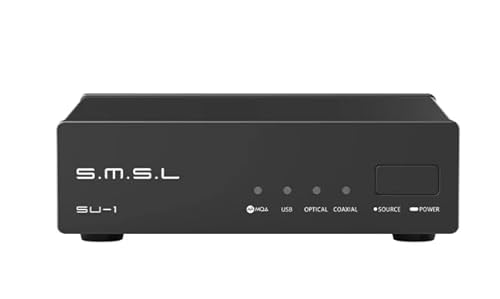
The SMSL SU-1 is the simplest DAC in this roundup and the best value for a desk system that already has an amplifier or powered speakers. It is a pure DAC with no headphone jack, no volume knob and no display, built around an AKM AK4493S chip and an XMOS XU316 USB receiver. That minimal design puts the whole budget into conversion quality. It is a budget-tier pick that suits listeners who already own the rest of the chain.
The SU-1 accepts USB, optical and coaxial digital inputs and outputs analog audio over a stereo RCA pair. Format support is generous for the tier, reaching up to 768kHz at 32-bit resolution over USB with DSD512 decoding, plus MQA and MQA-CD decoding for listeners who stream or play MQA-encoded material. The USB connection is driver-free on macOS and Linux, with a driver available for Windows at the highest sample rates.
Because the SU-1 has no headphone amplifier, it needs powered speakers, a separate headphone amplifier or an integrated amplifier to make sound. The RCA output delivers a standard 2V line level, which pairs well with almost any amplifier or powered speaker.
Specs
DAC chip: AKM AK4493S
USB receiver: XMOS XU316
Inputs: USB, optical, coaxial
Outputs: stereo RCA line out
Max sample rate: 768kHz at 32-bit over USB, DSD512, MQA and MQA-CD decoding
Headphone output: none, requires an amplifier or powered speakers
The iFi Zen DAC 3 is the premium pick in this roundup, aimed at listeners who want a desktop DAC with a warmer presentation and a balanced headphone output. It adds two features the other picks lack: TrueBass, which adds a gentle low-frequency lift for headphones that sound thin in the bass, and PowerMatch, a gain adjustment that matches the output to sensitive earphones or demanding full-size headphones.
Outputs include a balanced 4.4mm headphone jack, a 6.35mm headphone jack and RCA outputs that work as either a fixed line output or a variable preamp output, so the unit can feed powered speakers directly with volume control from the front knob. Format support reaches up to 768kHz at 32-bit resolution with DSD512 decoding and full MQA decoding. Output power reaches up to 280mW per channel from the balanced output into a 32-ohm load, which drives most headphones comfortably but falls short of the FiiO K11 for very demanding planar magnetic models. The lack of optical and coaxial inputs is the main limitation: a TV or CD player cannot connect without an extra converter.
Specs
DAC chip: Burr-Brown bit-perfect design with custom digital filtering
The FiiO KA11 is a dongle DAC, and it is the pick for anyone who wants better sound from a phone, tablet or laptop without carrying a separate box. It is barely larger than a USB connector, with a short fixed USB-C cable on one end and a 3.5mm headphone jack on the other. It draws power from the host device, so there is nothing to charge and no battery to wear out.
Despite its size, the KA11 supports up to 384kHz at 32-bit resolution with DSD256 decoding. Output power reaches up to 245mW per channel into a 16-ohm load, which is ample for in-ear monitors and efficient portable headphones. It works driver-free on Windows, macOS, Linux, Android and iOS with a USB-C port. The KA11 comes in USB-C and Lightning versions, so buyers should check the connector on their phone before ordering.
Specs
DAC chip: Cirrus Logic CS43131
Input: USB-C, fixed cable
Output: 3.5mm headphone jack
Max sample rate: 384kHz at 32-bit, DSD256
Output power: up to 245mW per channel at 16 ohms
Features: FiiO Control app support on Android, Hi-Res Audio certified
The Topping E30 II is a pure desktop DAC for listeners who already own a good amplifier or a pair of powered speakers and want a clean, flexible digital front end. It adds a remote control and a preamp mode that the SMSL SU-1 lacks, which suits a living room system.
Inputs cover USB, optical and coaxial digital sources, and the RCA outputs work in fixed DAC mode or variable preamp mode, so the E30 II can drive a power amplifier directly with volume control from the remote or the front knob. Format support reaches up to 768kHz at 32-bit resolution over USB with DSD512 decoding, and the coaxial and optical inputs handle up to 192kHz. It is a mid-range pick that fits neatly between the minimal SU-1 and the headphone-focused FiiO K11.
Specs
DAC chip: dual AKM AK4493S
USB receiver: XMOS XU208
Inputs: USB, optical, coaxial
Outputs: stereo RCA line out, fixed or variable preamp mode
Max sample rate: 768kHz at 32-bit over USB, DSD512
Headphone output: none, requires an amplifier or powered speakers
Features: remote control, input and sample rate display
Tier: mid-range
Budget DAC Comparison
DAC
Best For
Inputs
Headphone Output
Max Resolution
FiiO K11
All-round desktop use
USB, optical, coaxial
6.35mm and 4.4mm
384kHz, DSD256
SMSL SU-1
Pure DAC on a tight budget
USB, optical, coaxial
None
768kHz, DSD512
iFi Zen DAC 3
Warm sound, balanced output
USB-C
6.35mm and 4.4mm
768kHz, DSD512
FiiO KA11
Phones and laptops on the move
USB-C
3.5mm
384kHz, DSD256
Topping E30 II
Living room hi-fi systems
USB, optical, coaxial
None
768kHz, DSD512
Match the row to the setup, not to the specification sheet alone.
Frequently Asked Questions
Do I need a DAC if my laptop already has a headphone jack?
A laptop headphone jack works, but it uses a built-in converter that shares a crowded circuit board with power and wireless components. A dedicated budget DAC moves conversion outside the laptop, supplies it with cleaner power. The upgrade is most noticeable with good headphones and quiet recordings
What is the difference between a DAC and a headphone amplifier?
A DAC converts a digital audio signal into an analog signal, while a headphone amplifier raises that analog signal to a level that can drive headphones. Some units, such as the FiiO K11, combine both jobs. Pure DACs such as the SU-1 and E30 II need a separate amplifier or powered speakers.
Can a budget DAC improve sound from streaming services?
A budget DAC can improve sound from streaming services when the stream itself is high quality and the headphones or speakers are good enough to reveal the difference. Lossless and high-resolution tiers benefit most, because the DAC receives more musical detail to convert. With compressed streams the improvement is smaller.
Which budget DAC should I buy for a phone?
The FiiO KA11 is the best budget DAC for a phone, because it is a small USB-C dongle that draws power from the phone and needs no battery or separate cable. It supports high-resolution files and works driver-free on Android and iOS with a USB-C port. Phone owners with a Lightning connector should choose the Lightning version of the same model.
Conclusion
The best budget DAC depends on where the music plays. For a desk that serves headphones and speakers, the FiiO K11 covers the most ground with three inputs, balanced and single-ended headphone outputs and enough power for demanding headphones. The SMSL SU-1 suits systems that already have an amplifier, while the Topping E30 II adds a remote and preamp mode for living room listening. The iFi Zen DAC 3 suits computer listeners who value a warmer presentation and balanced output, and the FiiO KA11 is the obvious pick for phones and laptops on the move.
E
Emubox Editorial Team
We compare specs, materials and verified owner reviews before a product earns a spot. Rankings are never paid.
Affiliate disclosure. As an Amazon Associate we earn from qualifying purchases at no extra cost to you. Prices accurate as of the date shown.
Best 2mm 70 cm portable antennas compared: telescopic radio antennas near 70 cm, with connectors, bands and collapsed sizes explained before you buy today.
Find the best thermostat setting for winter and summer, with energy-saving setbacks, humidity tips, and smart schedules for a comfortable home year-round.
The best affordable business computer monitors balance sharp text, eye comfort and lasting value. Compare four reliable office displays built for long workdays.
Looking for the best inexpensive HD TVs non smart? Compare five genuinely non-smart HD televisions with tuners, HDMI inputs and simple setup for any small room.

 FiiO K11
 SMSL SU-1
 iFi Zen DAC 3
 FiiO KA11
 Topping E30 II









