We independently review everything we recommend. When you buy through our links, we may earn a commission. As an Amazon Associate we earn from qualifying purchases.
Best Budget Projectors: 5 Top Picks for Home Use 2026
Compare the best budget projectors for movies, gaming, and work. Five bright 1080p models, the specs that matter, and tips for choosing the right one.
The best budget projector for most people is the Epson Home Cinema 880, which pairs a bright 3,300-lumen 1080p image with 3LCD color, a built-in speaker, and simple streaming setup. The Optoma HD146X is the stronger pick for gaming thanks to its fast 16ms response time, while the BenQ HT2060 suits anyone who wants the most accurate color. The Epson Home Cinema 1080 adds a second HDMI port and a little more brightness, and the ViewSonic PA503W is the practical choice for bright rooms.
A budget projector makes sense when you want a screen far larger than any television at a similar outlay and you can control the light in the room at least partly. Every model here produces a native high-definition image and works with a streaming stick, a laptop, or a game console over HDMI. The trade-offs are real: lamps need replacing after thousands of hours and built-in speakers are modest. What you get instead is a genuinely big picture for movies, sports, gaming, and presentations.
The Epson Home Cinema 880 is the best all-round pick in this group. Its 3LCD engine produces 3,300 lumens of color brightness and the same of white brightness, and the native 1080p resolution keeps movies and sports sharp on screens well over 100 inches. The 16,000:1 contrast ratio gives dark scenes reasonable depth, and the built-in speaker means you can start watching with only a streaming device attached.
Setup is forgiving for a first projector. Auto picture skew straightens the image when the projector sits off-center, the 1.21 to 1.63 throw ratio covers typical living-room distances, and streaming device support means it is ready for movie night soon after unboxing. The 210-watt UHE lamp is rated for up to 6,000 hours in normal mode and up to 12,000 hours in eco mode. At 5.9 pounds it is light enough to move between rooms or carry to a friend’s house.
Specs
Resolution: 1080p (1920 x 1080), 3LCD
Brightness: 3,300 lumens color and white brightness
Contrast ratio: 16,000:1
Light source: 210W UHE lamp, up to 6,000 hours normal, up to 12,000 hours eco
Throw ratio: 1.21 to 1.63
Connectivity: HDMI 2.0, built-in speaker, streaming device support
Image adjustment: Auto picture skew
Dimensions: 11.9 x 9.3 x 3.2 inches including feet
The Optoma HD146X is the gaming pick in this group, and it earns that place with speed. Enhanced Gaming Mode delivers a 16ms response time, fast enough for competitive console and PC play, and Game Display Mode boosts shadow detail so dark corners of a game stay visible. The 3,600-lumen DLP image is the second brightest here, and the 25,000:1 contrast ratio is the highest in this roundup.
Installation is flexible thanks to a 1.1x zoom and vertical keystone correction of up to 40 degrees, so the projector works on a shelf or a ceiling mount without demanding exact placement. The lamp lasts up to 15,000 hours in eco mode at a quiet 26dB. HDMI-CEC powers the projector on and off together with connected devices. The main compromise is connectivity: a single HDMI 1.4 port means a streaming stick and a console cannot both stay connected without a switch.
Specs
Resolution: 1080p (1920 x 1080), DLP single-chip
Brightness: 3,600 lumens
Contrast ratio: 25,000:1
Light source: Lamp, up to 15,000 hours in eco mode
Gaming: Enhanced Gaming Mode, 16ms response time, Game Display Mode
Throw and zoom: Standard throw, 1.1x zoom, vertical keystone correction up to 40 degrees
The BenQ HT2060 is the picture-quality pick here, and the only model with an LED light source instead of a lamp. The LED engine is rated for 20,000 hours with no lamp to replace, and it produces wide DCI-P3 and Rec.709 color coverage with accurate out-of-the-box color. The 1080p HDR image supports 4K signals, and the 2,300 ANSI lumens are ample for a dark or dimmed room. Gamers get an 8.3ms input lag figure at 120Hz, the fastest response in this roundup.
Placement is the most flexible in this group. Vertical lens shift moves the image without tilting the projector, 2D keystone corrects the shape, and the 1.3x zoom covers a useful range of throw distances. Built-in 10-watt speakers handle casual viewing, and S/PDIF output feeds a soundbar or receiver for a fuller setup. The trade-offs are a lower brightness rating than the lamp models and no built-in smart platform, so a streaming stick is required.
Specs
Resolution: 1080p (1920 x 1080), HDR, 4K signal compatible
Brightness: 2,300 ANSI lumens
Light source: LED, rated for 20,000 hours, no lamp to replace
The Epson Home Cinema 1080 is the close sibling of the Home Cinema 880, with two differences that matter in a real setup: it is a little brighter at 3,400 lumens, and it has dual HDMI ports instead of one. That second port means a streaming stick and a game console can both stay connected without swapping cables or adding a switch, while the rest is familiar: a 3LCD engine with equal color and white brightness, native 1080p resolution, a 16,000:1 contrast ratio, and a built-in speaker for simple viewing.
Like the 880, the 1080 handles imperfect rooms well. The same 210-watt UHE lamp platform is rated for up to 6,000 hours in normal mode and up to 12,000 hours in eco mode, and auto picture skew corrects the image when the projector cannot sit square to the screen. Pick the 1080 when you have two HDMI sources to connect; pick the 880 when one port is enough.
Specs
Resolution: 1080p (1920 x 1080), 3LCD
Brightness: 3,400 lumens color and white brightness
Contrast ratio: 16,000:1
Light source: UHE lamp, up to 6,000 hours normal, up to 12,000 hours eco
Connectivity: Dual HDMI, built-in speaker, streaming device support
Image adjustment: Auto picture skew
Dimensions: 11.9 x 9.3 x 3.2 inches including feet
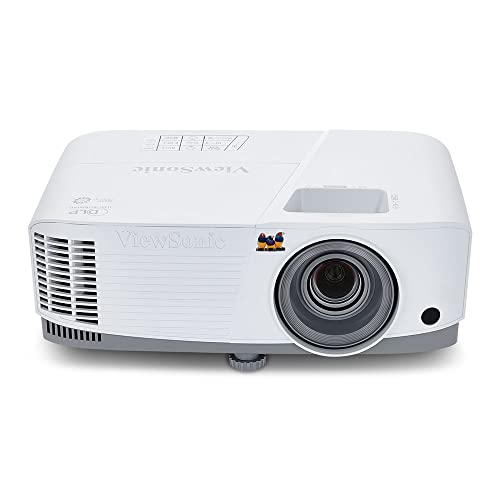
The ViewSonic PA503W is the bright-room and office pick in this group, and its headline figure explains why: 4,000 lumens, the highest brightness here, keeps slides and video legible with the lights on. The native WXGA resolution of 1280 x 800 in a 16:10 aspect ratio shows a little more vertical space than a 16:9 panel, and the 22,000:1 contrast ratio keeps text crisp.
The PA503W is also built for long, heavy use. The lamp lasts up to 5,000 hours in normal mode and up to 15,000 hours in SuperEco mode. Connectivity covers HDMI, VGA, and USB, and the 16ms input latency is low enough for casual gaming after work. The compromise is resolution: WXGA is a step below the 1080p models here, so fine movie detail is softer, and there is no built-in speaker listed, so plan on external audio.
Specs
Resolution: WXGA (1280 x 800), DLP, 16:10 aspect ratio
Brightness: 4,000 lumens
Contrast ratio: 22,000:1
Light source: 200W lamp, up to 5,000 hours normal, up to 15,000 hours SuperEco
Throw ratio: 1.55 to 1.70, 1.1x optical zoom
Image adjustment: Vertical keystone correction up to 40 degrees
Start with brightness and the room. A projector rated at 3,000 lumens or more holds up with some ambient light, and the 4,000-lumen ViewSonic PA503W is the safest choice for a bright living room or a classroom. In a dark or dimmed room, brightness matters less, while a 2,300-lumen LED image with strong color can look better than a brighter but less accurate one.
Resolution comes next. Native 1080p is the standard to aim for in this class, and four of the five models here offer it; the ViewSonic is the exception, trading resolution for brightness and a lower outlay. Check the word native on the listing, since some low-cost models advertise a supported resolution above what their panel displays.
Then think about the light source and the connections. A lamp projector is cheaper up front but needs a replacement lamp after thousands of hours, while the LED engine in the BenQ HT2060 runs for 20,000 hours with nothing to replace. Count your HDMI sources before you buy: the Epson Home Cinema 1080 has two ports, the Optoma HD146X has one, and a shortfall means adding a switch. Finally, measure the throw distance: check the throw ratio against the distance from your shelf or mount to the screen.
Frequently Asked Questions
How many lumens do I need for a budget projector?
For a dark room, 2,000 lumens or more is enough for a satisfying movie image, and the BenQ HT2060 proves the point with 2,300 ANSI lumens. For a room with lamps on or daylight coming in, aim for 3,000 lumens or more; the Epson models and the Optoma HD146X sit in that range.
Is 1080p enough, or should I buy a 4K projector?
For most living rooms, 1080p is enough. On a screen of 100 to 120 inches viewed from a normal sofa distance, a good 1080p image looks sharp, and every 1080p model here costs far less than a true 4K projector. The BenQ HT2060 accepts 4K signals and downscales them to its 1080p panel.
Do budget projectors need a screen?
No, a smooth white or light-grey wall works well for a first setup, and many people never buy a screen. A dedicated screen improves the image by giving a flat, evenly reflective surface with a defined border.
How long does a projector lamp last?
Lamp life depends on the mode. The Epson models here are rated for up to 6,000 hours in normal mode and up to 12,000 hours in eco mode, the Optoma HD146X lasts up to 15,000 hours in eco mode, and the ViewSonic PA503W lasts up to 15,000 hours in SuperEco mode. The BenQ HT2060 uses an LED light source rated for 20,000 hours with no lamp to replace.
Conclusion
The Epson Home Cinema 880 is the best budget projector for most people, thanks to its bright 3LCD image, built-in speaker, and forgiving setup. Gamers should pick the Optoma HD146X for its 16ms response time and strong contrast, while anyone building a dark movie room should look at the BenQ HT2060 for its accurate color. The Epson Home Cinema 1080 is the right choice when two HDMI ports matter, and the ViewSonic PA503W is the practical pick for bright rooms, classrooms, and presentations.
E
Emubox Editorial Team
We compare specs, materials and verified owner reviews before a product earns a spot. Rankings are never paid.
Affiliate disclosure. As an Amazon Associate we earn from qualifying purchases at no extra cost to you. Prices accurate as of the date shown.
Best 2mm 70 cm portable antennas compared: telescopic radio antennas near 70 cm, with connectors, bands and collapsed sizes explained before you buy today.
Find the best thermostat setting for winter and summer, with energy-saving setbacks, humidity tips, and smart schedules for a comfortable home year-round.
The best affordable business computer monitors balance sharp text, eye comfort and lasting value. Compare four reliable office displays built for long workdays.
Looking for the best inexpensive HD TVs non smart? Compare five genuinely non-smart HD televisions with tuners, HDMI inputs and simple setup for any small room.

 Epson Home Cinema 880
 Optoma HD146X
 BenQ HT2060
 Epson Home Cinema 1080
 ViewSonic PA503W









