We independently review everything we recommend. When you buy through our links, we may earn a commission. As an Amazon Associate we earn from qualifying purchases.
Best Budget Dash Cams: 5 Picks for Clear Trip Video
Compare five budget dash cams with supercapacitors, GPS logging, Wi-Fi apps and parking mode options, from discreet minis to full 4K front cameras.
Compare five budget dash cams with supercapacitors, GPS logging, Wi-Fi apps and parking mode options, from discreet minis to full 4K front cameras.
⭐ Key Takeaways
Quick answer: Our top pick is Rove R2-4K Dash Cam with WiFi and GPS, with Viofo A119 Mini 2 Dash Cam with Starvis 2 Sensor and 5GHz Wi-Fi as a strong alternative.
A dash cam is the witness that never blinks, never panics and never misremembers. When another driver disputes how a crash happened, continuous loop recording with a time stamp and, ideally, GPS speed and location data settles the argument in a way a verbal account cannot. Budget dash cams have improved sharply: supercapacitors that survive summer heat, modern sensors that read plates at night, and Wi-Fi apps for pulling clips to a phone are now normal at modest prices. The five picks below span the useful range, from a screen-free mini you can forget is there to full 4K cameras with proper displays, and all record on a loop so the card never fills up.
As an Amazon Associate, we earn from qualifying purchases.
Quick answer
For most drivers, the Rove R2-4K is the budget dash cam to start with: true 4K recording, built-in GPS and Wi-Fi, and a heat-proof supercapacitor. Choose the Viofo A119 Mini 2 for the sharpest 2K night video, the Garmin Dash Cam Mini 3 for the smallest, simplest camera, the Vantrue E1 Lite for buffered parking mode, and the Rexing V1 for a big-screen 4K wedge.
The R2-4K is the camera that defined the budget 4K category, and it still anchors it. It records the road ahead in Ultra HD 4K with a 150-degree lens wide enough to cover intersections and adjacent lanes, and a 2.4-inch screen on the back makes aiming the camera and reviewing clips at the roadside simple without touching a phone. Built-in GPS logs speed and location into the recording, which strengthens any insurance or police report, and built-in Wi-Fi pairs with the Rove app for downloads and settings.
Power comes from a supercapacitor rather than a lithium battery, the right choice for a device that bakes on a windshield: capacitors tolerate heat and cold far better and do not swell with age. A G-sensor locks the current file when it detects an impact, and a parking mode watches for bumps while the car is off when paired with an optional hardwire kit. It accepts large memory cards up to 512GB, so a high-endurance card can hold days of driving before the loop overwrites the oldest footage. For a first dash cam that does everything the category promises without options or guesswork, this remains the default recommendation.
Viofo A119 Mini 2 Dash Cam with Starvis 2 Sensor and 5GHz Wi-Fi
Runner-Up
Viofo A119 Mini 2 Dash Cam with Starvis 2 Sensor and 5GHz Wi-Fi
The A119 Mini 2 argues that sensor quality beats headline resolution. Its Sony Starvis 2 sensor records at 2K, at up to 60 frames per second in daylight or HDR at 30 frames for night driving, and that HDR mode is where it earns its reputation: headlights, street lighting and dark road surfaces hold together in one exposure, which is what reading a plate at night actually requires. The compact wedge body mounts flat against the windshield behind the mirror and stays discreet, with no screen to glow in your peripheral vision.
Voice control handles the commands you want while driving, like locking a clip or toggling audio, and 5GHz Wi-Fi makes pulling footage to the Viofo app noticeably quicker than older 2.4GHz cameras. GPS is built into the mount, logging route and speed, and power is supercapacitor-based for hot-climate reliability. Parking mode is available with the optional hardwire kit, with buffered recording on supported setups. The honest trade-offs: no display means setup happens through the app and button beeps, and the memory card is not included. Drivers who prioritize night clarity and a tidy install over a built-in screen will find this the strongest video quality per dollar in the group.
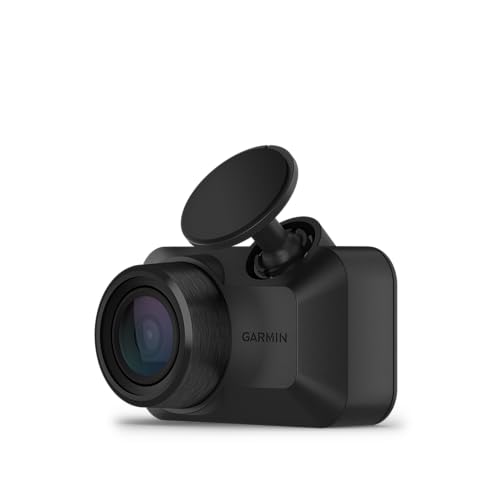
Garmin Dash Cam Mini 3, Ultracompact 1080p Dash Cam with 140-Degree Field of View
Garmin Dash Cam Mini 3, Ultracompact 1080p Dash Cam with 140-Degree Field of View
The Mini 3 is barely larger than a car key fob, and that is the entire point. It mounts behind the rearview mirror and effectively disappears, recording 1080p HD video through a 140-degree lens with a built-in Clarity polarizer in front of the glass, which cuts windshield glare and reflections on bright days, a small optical touch most budget cameras skip. There is no screen and almost no buttons; it starts with the car, records on a loop, and saves clips automatically when its incident detection feels an impact.
Control runs through voice commands and the Garmin Drive app, which handles live view for aiming, clip downloads and firmware updates. Garmin’s optional Vault cloud storage, which needs a paid subscription, can auto-upload saved clips when the camera is on Wi-Fi, but the camera is fully functional without it using a local memory card. Honest limits: 1080p reads plates at shorter distances than the 2K and 4K cameras here, and there is no GPS logging of speed in this mini model. Buy it if you want a fit-and-forget camera from a brand with a long support tail, and you value discretion over maximum detail.
The E1 Lite packs Vantrue’s feature set into a small cube that detaches from its GPS mount with a twist, handy if you park on the street and prefer to take the camera with you. It records 1080p through a wide 160-degree lens, connects to the Vantrue app over Wi-Fi for live view and downloads, and takes voice commands for locking clips and toggling recording while your hands stay on the wheel. The GPS lives in the adhesive mount, logging speed and route without adding bulk to the camera body itself.
Its parking mode is a highlight at this price: buffered motion detection can capture the seconds before an event as well as after, so a parking clip shows the approach and not just the aftermath, though like most cameras here it needs a hardwire kit or external battery to watch while parked. A supercapacitor handles power, avoiding the heat-swollen battery problem entirely. Night performance from the 1080p sensor is good rather than class-leading, and the field of view’s width adds some edge stretch, the usual trade for coverage. For renters, rideshare drivers and anyone who wants a removable, app-driven camera with real parking features, it is a well-judged budget package.
Rexing V1 4K Ultra HD Car Dash Cam with Wi-Fi and Supercapacitor
The Rexing V1 is the long-runner of this group, a wedge-shaped 4K camera with a proper 2.4-inch LCD, a 170-degree wide-angle lens and a control layout you can operate by feel. The wide lens covers multi-lane roads and broad intersections, and 4K recording gives you cropping headroom when a plate or sign sits near the edge of the frame. Wi-Fi and the Rexing Connect app handle clip transfers, and the camera supports cards up to 256GB for long loop retention.
A supercapacitor provides the backup power for clean file saves when the car shuts off, and the G-sensor locks collision footage against overwriting. Parking monitor functions are available with Rexing’s hardwire kits, sold separately in standard and smart versions, and an optional GPS logger module adds speed and location for drivers who want it. Two honest notes: the 170-degree view introduces noticeable fisheye curvature at the edges, and the V1’s size, while fine behind most mirrors, is larger than the mini cameras here. What you get in return is maturity: years of firmware updates, a deep accessory ecosystem and a design that accessory makers and installers know well.
How to choose
Start with the sensor, not the resolution number. A good 2K sensor with HDR often reads plates at night better than a cheap 4K sensor, so weigh night performance and dynamic range first. Decide on a screen: a built-in display simplifies aiming and roadside playback, while screen-free minis install cleaner and distract less. Insist on a supercapacitor if your car sits in sun; battery-based cameras fail early in hot climates. GPS logging adds speed and location evidence, and costs little. For parking coverage, budget for a hardwire kit and understand that motion and impact modes differ; buffered recording is the premium version. Finally, buy a high-endurance memory card rated for continuous recording, in the largest size the camera supports, because a worn card is the most common cause of missing footage.
Who should skip
Skip a budget dash cam if your car already has a factory camera system that records, or if your employer’s vehicle policy forbids recording devices. Drivers in jurisdictions that restrict windshield mounting or audio recording should resolve the legal position first; muting the microphone is an option on most models. If you want sentry-style cloud alerts and LTE live viewing, that is a different, pricier category with subscriptions attached. And skip the cheapest no-name cameras entirely: a dash cam that corrupts files or dies in summer heat is worse than none, because you only discover the failure after the crash you needed it for.
Frequently asked questions
Do dash cams record while the car is parked and off?
Only in parking mode, and most cameras need a hardwire kit connected to the fuse box, or an external battery pack, to run while parked without draining the car battery. Parking modes typically record on impact or motion detection rather than continuously. All five brands here offer a parking mode path; the camera alone, powered from a switched outlet, sleeps with the car.
What memory card should I use in a dash cam?
Use a high-endurance card designed for continuous video, sized at the camera’s maximum supported capacity where practical. Standard cards wear out under constant rewriting and are the leading cause of gaps in footage. Format the card in the camera every month or two, and replace it if the camera starts reporting card errors.
Is recording with a dash cam legal?
Video recording of public roads is broadly legal in the United States, but two details vary by state: where on the windshield you may mount a device, and whether recording audio inside the car needs consent from passengers. Most cameras let you disable audio. Check your state rules, and tell rideshare passengers the camera is present.
Does 4K really beat 2K or 1080p for dash cams?
It helps in daylight, where 4K keeps plates legible at longer distances and lets you crop into a frame. At night, sensor quality and HDR matter more than pixel count, which is why the 2K Viofo here can outperform cheaper 4K models after dark. Buy the best sensor you can afford; treat resolution as the second spec, not the first.
Final verdict
The Rove R2-4K is the easiest budget dash cam to recommend overall, with 4K video, GPS, Wi-Fi and a screen in one mature package. The Viofo A119 Mini 2 is the connoisseur’s pick for night footage, the Garmin Mini 3 wins on size and simplicity, the Vantrue E1 Lite suits drivers who want a removable camera with buffered parking mode, and the Rexing V1 remains a dependable big-screen 4K option. Pair any of them with a high-endurance card and you have evidence on your side from the first drive.
E
Emubox Editorial Team
We compare specs, materials and verified owner reviews before a product earns a spot. Rankings are never paid.
Affiliate disclosure. As an Amazon Associate we earn from qualifying purchases at no extra cost to you. Prices accurate as of the date shown.
Best 2mm 70 cm portable antennas compared: telescopic radio antennas near 70 cm, with connectors, bands and collapsed sizes explained before you buy today.
Find the best thermostat setting for winter and summer, with energy-saving setbacks, humidity tips, and smart schedules for a comfortable home year-round.
The best affordable business computer monitors balance sharp text, eye comfort and lasting value. Compare four reliable office displays built for long workdays.
Looking for the best inexpensive HD TVs non smart? Compare five genuinely non-smart HD televisions with tuners, HDMI inputs and simple setup for any small room.

 Rove R2-4K Dash Cam with WiFi and GPS
 Viofo A119 Mini 2 Dash Cam with Starvis 2 Sensor and 5GHz Wi-Fi
 Vantrue E1 Lite 1080P WiFi Mini Dash Cam with GPS









