
Our Short List of 3
All 5 Picks at a Glance
| Product | Specs | Action |
|---|---|---|
 Rigol DG1022Z Function and Arbitrary Waveform Generator | Check price on Amazon | |
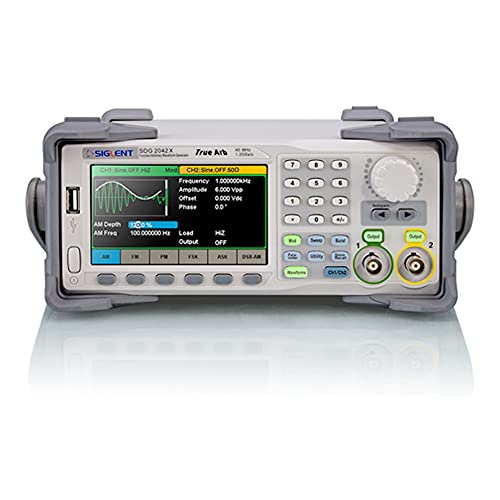 Siglent SDG2042X Function and Arbitrary Waveform Generator | Check price on Amazon | |
 UNI-T UTG962E Function and Arbitrary Waveform Generator | Check price on Amazon | |
 OWON DGE2070 Arbitrary Waveform Generator | Check price on Amazon | |
 Koolertron 15MHz DDS Signal Generator | Check price on Amazon |
Key takeaways
- Compare the best function generators for clean, stable waveforms and reliable bench testing, from compact DDS units to full arbitrary generators.
An oscilloscope shows what a circuit is doing, but it cannot make the circuit do anything. A function generator is the other half of the bench: it feeds a circuit a known, precisely controlled signal so you can watch how the board responds. That means injecting a clock into a controller board with a dead oscillator, simulating a sensor output while probing an analog front end, or sweeping a filter stage to find where the response collapses. The five generators below cover the realistic range for this work, from a compact budget DDS box to a 16-bit benchtop arbitrary waveform instrument, and every pick here is a dual-channel design.
As an Amazon Associate, we earn from qualifying purchases.
Quick answer
For most benches, the Rigol DG1022Z is the safest buy: two channels, 25 MHz sine and square output, a built-in 200 MHz counter and LAN control. The Siglent SDG2042X is the fidelity step-up, the UNI-T UTG962E and OWON DGE2070 pack high bandwidth into small cases, and the Koolertron is the budget starter.
Rigol DG1022Z Function and Arbitrary Waveform Generator
The DG1022Z is the entry model in Rigol’s DG1000Z series and the most complete all-rounder in this guide. It provides two fully independent channels with sine and square output to 25 MHz, pulse output to 15 MHz and ramp output to 500 kHz, generated at 200 MSa/s with 14-bit vertical resolution. Rigol’s SiFi signal fidelity architecture builds arbitrary waveforms point by point, which keeps jitter low on the clock and trigger signals a test bench depends on. Arbitrary memory is 2 Mpts per channel as standard, with a 16 Mpts upgrade available, and 160 built-in waveforms cover common test shapes without any editing. Two features lift it above the budget boxes: a built-in harmonics generator reaching the 8th order, and a seven-digit frequency counter that measures up to 200 MHz, useful for verifying a replacement crystal or clock buffer before soldering it in place. Modulation covers AM, FM, PM, ASK, FSK, PSK and PWM. Output amplitude runs from 1 mVpp to 10 Vpp into a 50 ohm load, and the rear panel carries USB Host, USB Device and LAN, so the generator can be scripted alongside an oscilloscope during repetitive board checks. For a general electronics bench that needs one dependable instrument, this is the balanced choice.
Siglent SDG2042X Function and Arbitrary Waveform Generator
The SDG2042X is the step up when waveform quality itself is the problem, for example when a marginal analog stage behaves differently depending on how clean the stimulus is. It is a dual-channel generator with 40 MHz bandwidth, a 1.2 GSa/s sample rate and 16-bit vertical resolution, a combination none of the other picks match. Siglent’s TrueArb architecture outputs arbitrary waveforms point by point rather than skipping samples at higher frequencies, and EasyPulse keeps pulse edges and widths accurate at settings where conventional DDS designs accumulate jitter. Arbitrary memory is 8 Mpts, output amplitude reaches up to 20 Vpp, and the front panel uses a 4.3-inch color display with a keypad layout that suits heads-down bench work. Modulation includes AM, FM, PM, FSK, ASK, PSK and PWM, plus sweep, burst and a harmonics function, and a built-in frequency counter is included. USB and LAN interfaces support remote control for scripted test sequences. For a bench that also services audio gear, servo controllers or precision analog boards, this is the generator whose own distortion is least likely to contaminate the measurement.
UNI-T UTG962E Function and Arbitrary Waveform Generator
The UTG962E takes the opposite approach to the Siglent: maximum bandwidth in minimum space. This compact dual-channel generator reaches 60 MHz on sine waves while sampling at 200 MSa/s with 14-bit resolution, and its 4.3-inch TFT display is larger and clearer than the screens on most full-size budget units. Frequency resolution is one microhertz across the range, and amplitude runs from 1 mVpp to 10 Vpp into 50 ohms, doubling into a high-impedance load. Modulation covers AM, FM, PM and FSK, with linear and logarithmic sweep for filter and amplifier response checks. The trade-offs are real: there is no built-in frequency counter, arbitrary waveform storage is limited to a modest set of slots, and square wave performance falls well short of the 60 MHz sine headline, as it does on every generator here. The unit is USB powered and small enough to sit on top of a scope or move between benches, and the listing bundles BNC cables, which the benchtop Rigol and Siglent do not. Choose it when bench space is tight but clock and intermediate-frequency work still demands headroom.
OWON DGE2070 Arbitrary Waveform Generator
The DGE2070 is the value pick for buyers who want bandwidth and PC automation together. It offers two channels with sine output to 70 MHz, the highest figure in this guide, sampled at 300 MSa/s with 14-bit resolution. Arbitrary memory is a shallow 8K points, so it suits standard shapes and short captured bursts rather than long replayed waveforms, but 150 built-in waveforms cover most bench needs. Its standout feature at this level is connectivity: full SCPI command support and LabVIEW compatibility let a script step the generator through a frequency response test or an ADC linearity check while a scope logs the results. The display is a basic 3.6-inch LCD, there is no built-in frequency counter, and square wave output tops out well below the sine rating. One ordering caution from the listing itself: the same product family includes the 35 MHz DGE2035, so confirm the 70 MHz DGE2070 variant is the one selected before checkout. For a small lab automating repetitive board or power-supply checks, that scripting support matters more than deep memory.
Koolertron 15MHz DDS Signal Generator
The Koolertron is the budget entry point, built on the widely sold dual-channel DDS platform that also appears under several other badges. Sine output reaches 15 MHz, which is still far beyond the audio, sensor and logic signals that dominate board-level repair, and sampling runs at 200 MSa/s with 14-bit resolution per the listing. Both channels are independent, a built-in frequency counter handles quick checks of oscillators and PWM outputs, and sweep mode covers basic filter work. Storage for 60 user-defined arbitrary waveforms is generous for the class, and the 2.4-inch color display keeps settings visible without a PC. What you give up against the Rigol is build quality, documentation depth, counter range and the LAN interface; what you keep is every core function a first bench needs. Amplitude and offset need care before connecting to low-voltage logic, as with any generator. For a technician adding stimulus capability to a bench that already has a good scope and power supply, this is the least expensive way to close the loop between injecting a signal and observing the response.
How to choose
Start with the signals you actually inject. Most board-level repair work, clock substitution, sensor simulation and audio testing, happens below a few megahertz, so a 15 or 25 MHz generator is not a compromise. Spend on sample rate and resolution instead if you replay captured waveforms or need clean pulses: 16-bit TrueArb output behaves noticeably better at low amplitudes. Check the square and pulse limits, not just the sine headline, if you generate clocks. A built-in counter earns its place on a bench because it verifies crystals and clock outputs without a second instrument. Confirm the output range covers your work, and remember that amplitude halves into a 50 ohm load compared with a high-impedance one. Finally, match the interface to your habits: LAN or SCPI control pays off when the same test runs on every board that crosses the bench, while a big front-panel display matters more for manual, one-off diagnosis. BNC leads are often excluded, so budget for them if the listing does not bundle cables.
Who should skip
Skip a function generator if your bench work is purely mechanical or media-focused: head swaps, platter work and clean-room recovery gain nothing from a signal source. Skip it, too, if you only ever check power rails and continuity, where a good multimeter and bench supply already answer the question. Owners of a modern oscilloscope with a built-in waveform generator option may already have enough stimulus for occasional clock injection, and anyone whose work is exclusively high-frequency RF should be shopping for a dedicated RF signal generator instead, since none of these instruments is designed for that role.
Frequently Asked Questions
Do I need a function generator if my oscilloscope has a built-in one?
Often not. Many mid-range scopes offer an optional single-channel generator that handles basic clock injection and sensor simulation. A standalone unit earns its bench space when you need two independent channels, higher amplitude, deeper arbitrary memory or counter functions the built-in option lacks, or when the scope’s generator cannot run while the scope measures a related signal.
What bandwidth do I need for board-level repair work?
Far less than the headline numbers suggest. Clock signals on controller boards, servo test tones, sensor outputs and audio paths almost all sit below a few megahertz. A 15 to 25 MHz generator covers that work comfortably. Higher bandwidth only matters for fast logic edges, intermediate-frequency stages or radio circuits, and even then the square wave limit, not the sine rating, is the figure to check.
Can a function generator damage a board under test?
Yes, if amplitude and offset are set carelessly. Many generators output up to 10 or 20 Vpp, which will destroy a 3.3 volt logic input. Set a low amplitude and the correct offset first, confirm the signal on an oscilloscope, and only then connect it to the board. Starting conservative and raising the level slowly is the safe routine for any unknown input stage.
What is the difference between a function generator and an arbitrary waveform generator?
A classic function generator produces standard shapes: sine, square, triangle, pulse and noise. An arbitrary waveform generator adds the ability to replay waveforms defined point by point, including signals captured from a real circuit. Every model in this guide does both to some degree; they differ in memory depth, sample rate and resolution, which decide how faithfully a complex captured waveform is reproduced.
Final verdict
The Rigol DG1022Z is the default recommendation: complete, well documented and fairly priced for a real instrument, with a counter that suits diagnostic work. Move up to the Siglent SDG2042X when signal purity and arbitrary waveform fidelity are the point of the test. The UNI-T UTG962E and OWON DGE2070 trade depth for bandwidth and portability, the OWON adding the scripting support small labs want. The Koolertron remains the sensible first generator for a bench on a budget. Any of the five turns a passive bench into an active one.
Product and ASIN Reference
| Product | ASIN |
|---|---|
| Rigol DG1022Z Function and Arbitrary Waveform Generator | B09RK3ZH5T |
| Siglent SDG2042X Function and Arbitrary Waveform Generator | B0BY6K3551 |
| UNI-T UTG962E Function and Arbitrary Waveform Generator | B09Y2TH8K8 |
| OWON DGE2070 Arbitrary Waveform Generator | B0CL2PGB7M |
| Koolertron 15MHz DDS Signal Generator | B086W1HB4K |









