Key takeaways
- Compare three red dot sights that ship with co-witness mounts for an AR-15, with mount heights, dot sizes and battery figures from each Amazon listing.
A red dot only lines up with your iron sights if the mount in the box puts the dot at the right height, and that height is decided before you ever fire a shot. Pick a sight that sits too low and the front post crowds the window; pick one on a tall riser you did not need and your cheek weld changes. The real decision is which co-witness height matches the irons already on your rifle, and whether the mount that creates it is included or sold separately.

This guide is for AR-15 owners running a fixed front post or flip-up backup irons, for home-defense carbine setups, and for first-time dot buyers who want the irons usable through the glass. Every sight below was chosen from its Amazon listing name and specifications: the mount type and height printed in the listing, the dot size, and the battery system the maker states.
Quick Picks
As an Amazon Associate we earn from qualifying purchases.
| Product | Best for | Key spec from title |
|---|---|---|
| SIG Sauer Romeo5 | Absolute co-witness with a fixed front post | 2 MOA dot, 1.41 in riser mount included |
| Holosun HS510C | Lower 1/3 height with a quick-detach lever | 2 MOA dot in a 65 MOA circle, QD mount |
| Vortex Strikefire II | Tube body pushed forward for a magnifier | 4 MOA dot, offset cantilever mount included |
How to Choose
Decide Between Absolute and Lower 1/3 Height
Absolute co-witness places the dot at the same height as your iron sights, so the front post sits centered in the window and the dot rests right on the post tip when both are zeroed. Lower 1/3 raises the optic slightly, dropping the irons into the bottom of the glass where they stay visible but out of the way. Fixed front posts usually pair better with absolute height, while flip-up sets work well either way. Neither is better in the abstract; the wrong match for your irons is the only bad pick.
Confirm the Mount Is in the Box
Many red dots ship with only a low mount meant for shotguns or pistol-caliber hosts, and the AR-height riser is a separate purchase that adds a second decision and a second parcel. The listings in this guide were picked because the mount is part of the product: a riser in the box, a quick-detach base at co-witness height, or a cantilever ring that sets the height itself. Before ordering any sight, read the included components line of the listing and match the stated mount height against your iron sight setup.
Match Dot Size and Reticle Shape to Your Shooting
A 2 MOA dot covers about two inches at 100 yards, which keeps it precise enough for deliberate shots at carbine distances while staying easy to find on the draw. A 4 MOA dot is faster to pick up at close range but covers more of a small target. Circle-dot reticles add a large ring around the center dot that pulls your eye to the middle of the window, which helps when shooting from awkward positions. Think about your typical distance first, then pick the reticle that serves it.
Check the Battery System and Controls
Runtime figures in these listings run from tens of thousands of hours upward, but the battery type matters as much as the number: CR2032 cells are sold everywhere, while the CR2 used by some tube sights is less common in range bags. Motion-activated illumination wakes the dot when the rifle moves and sleeps when it sits, stretching real-world life far past the stated figure. Also check how brightness is adjusted, because push buttons, top knobs and side dials each behave differently with gloves on.
The 3 Best Options
SIG Sauer Romeo5
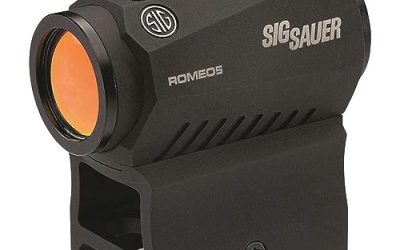
The SIG Sauer Romeo5 solves the mount problem by shipping two of them: a low mount for other hosts and a 1.41 inch riser that sets the dot at absolute co-witness height on a flat-top AR. That makes it the natural pick for a rifle with a fixed front sight post, where the irons should sit centered in the window. MOTAC illumination wakes the dot when the rifle is picked up and shuts it down when the rifle rests, so a carbine that lives by the door stays ready without draining the cell.
Specs
- Reticle: 2 MOA red dot
- Mounts included: low mount and 1.41 in riser mount for absolute co-witness
- Illumination: 10 settings, 8 daylight and 2 night vision compatible
- Battery: CR2032, 40,000+ hours with MOTAC motion activation
- Housing: sealed to IPX-7 immersion protection
- Weight: 5.1 oz
Best for: Absolute co-witness on a rifle with a fixed front post or flip-ups you want centered.
Watch out for: The two included mounts give you absolute height or low height, nothing between; if you later decide you prefer lower 1/3, the mount has to change.
ASIN: B01C95I8N4
Holosun HS510C
The Holosun HS510C takes the opposite approach to height: its quick-detach base holds the open reflex housing at lower 1/3 co-witness, so backup irons sit low in the window and the view stays clear for both-eyes-open shooting. The multi-reticle system lets you run the 2 MOA dot alone, the 65 MOA circle alone, or both together, and the circle is genuinely useful when the rifle comes up fast from a sling. Shake Awake wakes the sight on movement, and Solar Failsafe keeps a dot visible in bright light even with a weak battery.
Specs
- Reticle: 2 MOA dot and 65 MOA circle, switchable through the multi-reticle system
- Mount: quick-detach Picatinny base at lower 1/3 co-witness height
- Illumination: 12 settings, 10 daylight and 2 night vision compatible
- Battery: CR2032, up to 50,000 hours, with Solar Failsafe and Shake Awake
- Design: open reflex housing with a protective hood
- Weight: 4.9 oz
Best for: Lower 1/3 co-witness with flip-up irons and a mount you can pull off by hand.
Watch out for: The open emitter design leaves the emitter window exposed to dust and rain in a way enclosed tube sights do not, so it needs a wipe before a range session.
ASIN: B01MT5RJLD
Vortex Strikefire II
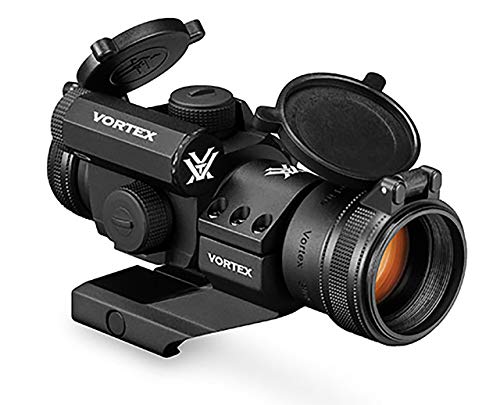
The Vortex Strikefire II is the tube-style entry here, and its listing leads with the mounting answer: an offset cantilever mount is provided, pushing the 30 mm body forward so a magnifier and backup irons can share the same rail behind it. The cantilever sets the sight at lower 1/3 co-witness height. Its 4 MOA dot is the largest in this guide, which suits close, fast work better than small targets at distance, and the rear-facing power controls stay easy to reach with the rifle shouldered.
Specs
- Reticle: 4 MOA dot
- Mount: offset cantilever mount included, lower 1/3 co-witness height
- Illumination: 11 settings
- Battery: CR2, up to 80,000 hours at setting 6
- Body: 30 mm tube with flip cap covers included
- Controls: rear-facing power and brightness buttons
Best for: A forward-mounted tube sight with room left on the rail for a magnifier.
Watch out for: The CR2 battery is far less common than a CR2032, so spares belong in the range bag from day one; the long tube body also eats rail space.
ASIN: B081TK97FC
Which One Fits Your Situation
Your Rifle Has a Fixed Front Sight Post
Choose the Romeo5 on its included riser. Absolute co-witness puts the post in the center of the window where your eye already expects it, and the dot and post confirm each other at a glance. Because the riser is in the box, the rifle is set up correctly the day the parcel arrives.
You Run Flip-Ups and May Add a Magnifier Later
Choose the Strikefire II. The cantilever mount moves the tube forward, leaving rail room behind it for a flip-to-side magnifier, and the lower 1/3 height keeps folded or deployed flip-ups from cluttering the view. The HS510C also fits this pattern well if you prefer an open window over a tube body.
The Carbine Sits Ready for Months at a Time
Choose between the Romeo5 and the HS510C, because both wake their dots with motion and sleep when the rifle is still. That behavior matters more than the headline runtime figure for a rifle that waits in a corner, since the sight spends nearly all of its life asleep rather than lit.
This Is Your First Red Dot
Choose the Romeo5. Two mounts in the box mean you can try absolute height on the AR today and still have the low mount for another host later, and the control layout is simple enough to learn in one range trip. Start with the irons zeroed first, then bring the dot to them.
Common Mistakes
- Buying a sight that ships with only a low mount, then discovering the dot sits buried behind the front post on a flat-top AR.
- Zeroing the dot to the irons instead of zeroing each system on its own, which leaves both slightly wrong.
- Mounting the sight so far back that flip-up rear irons cannot deploy, or so far forward that it bridges onto the handguard.
- Leaving the brightness at maximum indoors, which blooms the dot and drains the battery faster than the stated runtime assumes.
- Skipping spare batteries because the runtime figure sounds endless, then finding the cell dead at the start of a range day.
Frequently Asked Questions
What is the difference between absolute and lower 1/3 co-witness?
With absolute co-witness, the dot sits at the exact height of your iron sights, so the front post appears in the center of the window. Lower 1/3 raises the optic slightly, moving the irons into the bottom third of the glass. Both keep the irons usable; the choice is about where you want the post sitting in your view.
Can I still use my iron sights if the dot fails?
Yes, provided the mount height matches your irons and the rear sight can deploy. With an absolute setup you look straight through the window and use the irons as normal. With lower 1/3 the irons appear in the bottom of the glass, which is still a complete sight picture, just lower than you may be used to.
Will these sights fit a standard AR-15 top rail?
Each sight in this guide mounts to a Picatinny rail, which is the standard flat-top AR-15 receiver rail. The Romeo5 uses its included riser or low mount, the HS510C clamps on with its quick-detach base, and the Strikefire II uses its cantilever ring. Check that your rear iron sight and any magnifier leave enough rail slots free.
Which dot size suits an AR-15 best?
A 2 MOA dot is the common middle ground: small enough for deliberate shots at 100 yards, large enough to find quickly up close. A 4 MOA dot, like the Strikefire II carries, favors speed at short range and covers more of a distant target. Circle-dot reticles split the difference by adding a big ring for fast pickup.