Our Short List of 3
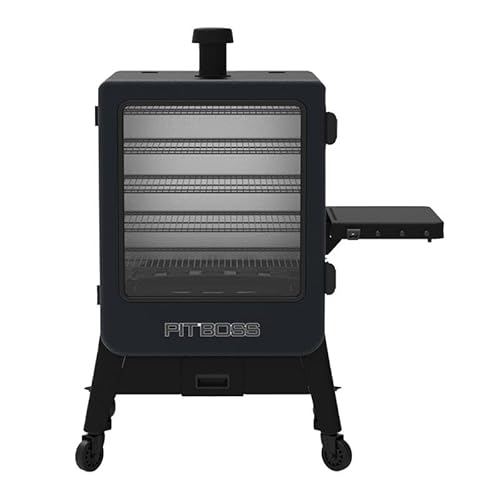
- Best for: cooks who regularly fill five racks at once and want the longest unattended runs.
- Cooking space: 2,224 sq. in. across 5 racks
- Temperature range: 130°F to 420°F
- Hopper capacity: 75 lb.
- Controller: LCD digital controller with WiFi and Bluetooth

- Best for: jerky and sausage makers who want two probes watching different racks at once.
- Model: PGVXXLC, vertical form factor
- Total rack capacity: up to 8 racks, 2,408 sq. in.
- Included racks: 4 smoking racks, 3 jerky racks, 1 hanging rack with 12 sausage hooks
- Meat probes: 2 included

- Best for: smaller patios and households that still want five racks and app control.
- Cooking space: 1,118 sq. in. across 5 racks
- Temperature range: 130°F to 420°F
- Hopper capacity: 50 lb.
- Controller: LCD digital controller with WiFi and Bluetooth
All 3 Picks at a Glance
| Product | Specs | Action |
|---|---|---|
| Pit Boss Navigator 6-Series Vertical Pellet Smoker |
| Check price on Amazon |
| Camp Chef XXL WiFi Vertical Pellet Smoker |
| Check price on Amazon |
| Pit Boss Navigator 3-Series Vertical Pellet Smoker |
| Check price on Amazon |
Key takeaways
- Compare vertical pellet smokers whose listings include meat probes and probe ports, with rack space, hopper size and temperature range for each pick.
A vertical pellet smoker earns its keep on long, unattended cooks, and that only works if you can watch internal meat temperature without cracking the door and dumping heat and smoke. The real decision is therefore twofold: how much rack space and hopper capacity your typical cook actually needs, and whether the controller gives you proper meat probe ports so a brisket on the middle rack and ribs up top can each report their own progress.
This guide is for backyard cooks moving up from a barrel grill, jerky and sausage makers who need stacked racks, and anyone planning overnight cooks. Every pick below is a true vertical cabinet burning wood pellets, chosen because its Amazon listing names an included meat probe that plugs into the controller, and the specifications quoted come from those listing pages rather than from brochures or guesswork.
Quick Picks
As an Amazon Associate we earn from qualifying purchases.
| Product | Best for | Key spec |
|---|---|---|
| Pit Boss Navigator 6-Series Vertical | Big batches and freezer-stocking cooks | 2,224 sq. in. across 5 racks |
| Camp Chef XXL WiFi Vertical Pellet Smoker | Jerky, sausage and mixed rack loads | Includes 2 meat probes |
| Pit Boss Navigator 3-Series Vertical | Smaller patios that still cook for a crowd | 1,118 sq. in. across 5 racks |
How to Choose
Count probe ports against the racks you actually fill
A single included probe tells you about one cut of meat, yet a loaded cabinet rarely holds one cut. Five racks might carry a brisket, two pork shoulders and a tray of wings, each finishing at a different moment. Look at how many probe inputs the controller offers and how many probes ship in the box, because spare ports are useless on cook day if the second probe is a separate purchase. App-connected models add another layer here: probe readings pushed to your phone mean an overnight cook can be checked from bed instead of from the patio door.
Match rack area to your largest realistic cook
Vertical cabinets quote total area across every rack, so divide the headline figure by the rack count to picture a single shelf. A whole packer brisket or a full rack of ribs needs one shelf with elbow room, not a share of five crowded ones. The Navigator 6-Series spreads 2,224 square inches over five racks, while the Camp Chef XXL stacks up to eight rack positions when jerky and hanging racks are counted. Buy for the biggest cook you genuinely repeat, since an oversized cabinet burns extra pellets heating empty air on small weeknight sessions.
Weigh hopper capacity against your longest session
Hopper size decides whether a smoker can run while you sleep. A modest cabinet sipping pellets at low temperature stretches a small hopper surprisingly far, but cold wind and higher settings drain it faster. The two Pit Boss Navigators carry unusually large hoppers, 75 pounds on the 6-Series and 50 pounds on the 3-Series, while the Camp Chef XXL holds 18 pounds and leans on efficiency instead. Also check for a hopper cleanout door and a sight window, because swapping pellet flavours between cooks and spotting a low hopper at a glance both matter mid-season.
Check the temperature range and controller style
Cabinet smokers are low-and-slow tools, and their ceilings reflect that. The Pit Boss Navigators run from 130 to 420 degrees Fahrenheit, low enough for gentle jerky drying and high enough to finish chicken skin, whereas the Camp Chef XXL tops out at 350 degrees and concentrates on the smoking band. Decide which end matters more to your cooking. Controller style matters too: a dial-in digital board is simple and direct, while a PID controller with adjustable smoke levels, like the Camp Chef unit, holds tighter temperatures and lets you dial smoke intensity up or down.
The 3 Best Options
Pit Boss Navigator 6-Series Vertical Pellet Smoker
- Best for: cooks who regularly fill five racks at once and want the longest unattended runs.
- Cooking space: 2,224 sq. in. across 5 racks
- Temperature range: 130°F to 420°F
- Hopper capacity: 75 lb.
- Controller: LCD digital controller with WiFi and Bluetooth
cooks who regularly fill five racks at once and want the longest unattended runs.
its footprint and weight demand a dedicated, level spot; confirm your patio space and door clearances before ordering.
Choose this cabinet when capacity is the whole point of going vertical. Its listing pairs 2,224 square inches of cooking space across five racks with a 75-pound hopper, a combination aimed at party batches, competition practice and stocking the freezer in a single run. WiFi and Bluetooth control through an LCD digital controller means set temperatures and the included meat probe can be followed from indoors, and the 130 to 420 degree range reaches low enough for jerky yet high enough for poultry. It is a large, heavy cabinet, so it suits a permanent patio spot rather than frequent moving.
Camp Chef XXL WiFi Vertical Pellet Smoker
- Best for: jerky and sausage makers who want two probes watching different racks at once.
- Model: PGVXXLC, vertical form factor
- Total rack capacity: up to 8 racks, 2,408 sq. in.
- Included racks: 4 smoking racks, 3 jerky racks, 1 hanging rack with 12 sausage hooks
- Meat probes: 2 included
jerky and sausage makers who want two probes watching different racks at once.
the 350-degree ceiling rules out higher-heat finishing, and the 18-pound hopper is the smallest here, so check it suits your longest cooks.
Pick the XXL when your smoking leans toward jerky, sausage and mixed loads rather than a few large cuts. The listing, model PGVXXLC, includes two meat probes, which suits a cabinet where different racks finish at different times, and the rack set is the most varied here: four standard smoking racks, three jerky racks and a hanging rack with twelve sausage hooks, holding up to eight racks and 2,408 square inches in total. A WiFi PID controller works with the Camp Chef Connect app and offers adjustable smoke settings from 1 to 10, while the ash cleanout system simplifies the least pleasant chore.
Pit Boss Navigator 3-Series Vertical Pellet Smoker
- Best for: smaller patios and households that still want five racks and app control.
- Cooking space: 1,118 sq. in. across 5 racks
- Temperature range: 130°F to 420°F
- Hopper capacity: 50 lb.
- Controller: LCD digital controller with WiFi and Bluetooth
smaller patios and households that still want five racks and app control.
only one probe is included, so cooks tracking several cuts should confirm a spare probe is available for the extra port before the first big session.
Take the 3-Series when you want the Navigator formula in a narrower cabinet. The listing offers 1,118 square inches across five racks, which still swallows several shoulders or a serious jerky batch, and the 50-pound hopper is generous for the footprint, supporting long low cooks without refilling. It keeps the same connected controller as its bigger sibling, with WiFi and Bluetooth, an LCD digital display and one meat probe included, plus the same 130 to 420 degree temperature range. For a smaller household that smokes most weekends, this is the balanced middle ground between patio space and genuine batch capacity.
Which One Fits Your Situation
You smoke for parties, events or the freezer
The Navigator 6-Series is the natural fit, because its five racks and 2,224 square inches let you run briskets, shoulders and ribs together instead of in relays. The 75-pound hopper supports the long, low sessions those batches demand, and app control with the included meat probe keeps one eye on the biggest cut while you deal with guests, sides and everything else happening away from the patio.
Jerky, sausage and snack sticks are your main projects
Choose the Camp Chef XXL, since its rack set was clearly designed around your cooking: dedicated jerky racks, a hanging rack with twelve hooks and room for eight racks overall. Two included meat probes let you verify a shoulder on one level while a different cut cooks elsewhere, and the adjustable smoke settings help when a batch needs heavier smoke early and a gentler finish later in the session.
Your patio is small but your cooks are not
The Navigator 3-Series threads this needle well. Its cabinet takes up less ground than the 6-Series while keeping five racks, a 50-pound hopper and the same temperature range and connectivity. Weeknight ribs, weekend shoulders and the occasional jerky run all fit comfortably, and you are not heating a cavernous chamber for a single chicken the way an oversized cabinet would force you to.
You are buying your first pellet smoker
Start with whichever of the three matches your space, then lean on the probe ports from day one. Beginners often judge doneness by time or by opening the door, and both habits sabotage a cook. A wired probe reporting to the controller, checked through the app on connected models, teaches you how your cabinet behaves across racks and weather far faster than guesswork, whichever size you pick.
Common Mistakes
- Judging capacity by the headline area alone, without dividing it by rack count to see whether a whole brisket actually fits on one shelf.
- Assuming every port comes with a probe in the box, then discovering on cook day that the second input needs a probe bought separately.
- Routing probe cables through the door seal carelessly, which pinches the wire, leaks smoke and heat, and can ruin the probe over time.
- Filling a large hopper and leaving pellets sitting through humid weeks, where moisture swells them and causes auger jams on the next cook.
- Ignoring the temperature ceiling: a cabinet that tops out at 350 degrees will not crisp poultry skin the way a hotter model can.
Frequently Asked Questions
Why do meat probe ports matter on a vertical smoker?
Stacked racks cook at slightly different rates, and opening the door to check each level releases the heat and smoke the cabinet has built up. A probe left in the meat reports internal temperature continuously to the controller or app, so each cut can be pulled at the right moment while the door stays shut and conditions inside remain stable.
How many probes do I realistically need?
One probe covers a single-cut cook, which is many weeknight sessions. Two probes earn their place when different meats share the cabinet, since a brisket and a pork shoulder rarely finish together. Check both the port count on the controller and the number of probes included in the box, because those two figures are often different on the same smoker.
Can a vertical pellet smoker replace a regular grill?
Not completely. These cabinets excel at smoking, roasting and baking within their stated ranges, topping out between 350 and 420 degrees depending on the model, and none of the picks here is built for direct-flame searing. Most owners keep a small grill for steaks and burgers and let the vertical smoker handle the low-and-slow work it was designed for.
What pellets should I run in a cabinet smoker?
Use food-grade hardwood pellets from a reputable maker, and store them somewhere dry, since damp pellets crumble, feed poorly and smoke weakly. Flavour choice is personal: oak and hickory suit beef, while fruitwoods like apple and cherry are gentler on poultry and fish. Avoid heating pellets entirely, because they can contain binders and woods not intended for contact with food.