We independently review everything we recommend. When you buy through our links, we may earn a commission. As an Amazon Associate we earn from qualifying purchases.
Best Budget Weather Stations: 5 Picks for Home Use
Compare five budget home weather stations with wireless outdoor sensors, wind and rain tracking, Wi-Fi uploads and clear color displays for home use.
Compare five budget home weather stations with wireless outdoor sensors, wind and rain tracking, Wi-Fi uploads and clear color displays for home use.
⭐ Key Takeaways
Quick answer: Our top pick is Ambient Weather WS-2902 WiFi Smart Weather Station, with AcuRite Iris (5-in-1) Weather Station with Digital Display (01512M) as a strong alternative.
A phone app tells you the weather at the nearest airport or a grid point miles away. A home weather station tells you what is actually happening in your own yard: the gust that just hit the fence, the rain your garden really got, and the temperature on your shaded patio rather than across town. Budget models have closed the gap with expensive ones in recent years, adding Wi-Fi uploads, color consoles and multi-sensor arrays at modest prices. The five picks below cover the main shapes of the category, from a full wireless array with app sharing to a simple indoor-outdoor display that needs no internet at all.
As an Amazon Associate, we earn from qualifying purchases.
Quick answer
For most homes, the Ambient Weather WS-2902 is the budget station to start with: a wireless sensor array, a color console and Wi-Fi uploads to weather networks. Pick the AcuRite Iris 01512M if you want wind and rain data without an internet connection, the Sainlogic WS3500 for a bigger display, the Ecowitt Wittboy GW2001 for a no-moving-parts sensor, and the La Crosse 308-1414B for temperature and humidity only.
Ambient Weather WS-2902 WiFi Smart Weather Station
Top Pick
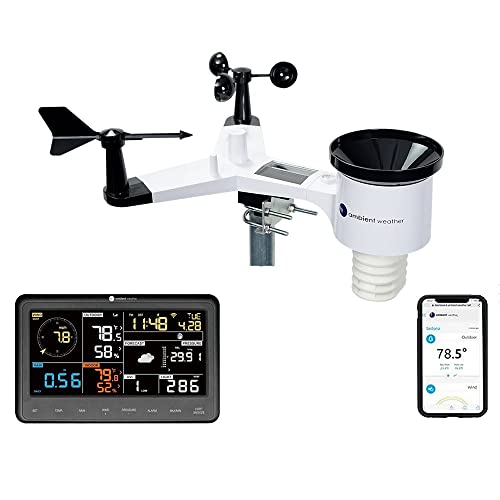
Ambient Weather WS-2902 WiFi Smart Weather Station
The WS-2902 is the reference point for budget weather stations, built around the Osprey sensor array that combines wind cups, a wind vane, a rain collector, temperature and humidity sensors, and a solar panel with battery backup in one outdoor unit. It reports wind speed and direction, rainfall, outdoor temperature and humidity, UV and solar radiation, and it sends readings to a color console inside while also uploading over Wi-Fi to Weather Underground, AmbientWeather.net and other networks, so you can check your yard from a phone anywhere.
Setup is the usual pattern for this class: mount the array on a pole or rail with a clear view of the sky, keep it level so the rain gauge reads honestly, and give the console a spot where you will actually glance at it. The console shows current conditions, daily highs and lows, and forecast information based on pressure changes. Because the sensor is solar-assisted, you are not climbing up to swap batteries every few months. For gardeners, commuters deciding on a jacket, and anyone who enjoys watching a storm roll in with real numbers attached, this is the most complete budget package in the group.
AcuRite Iris (5-in-1) Weather Station with Digital Display (01512M)
Runner-Up
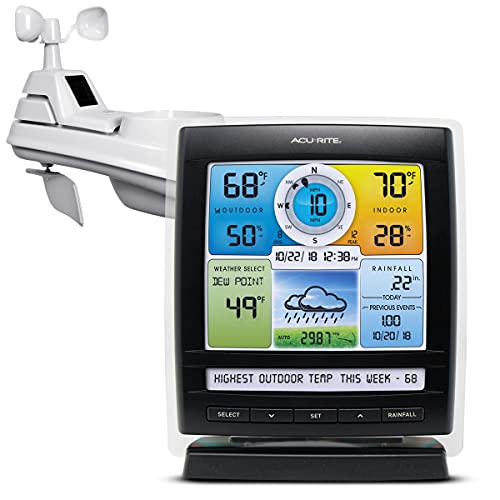
AcuRite Iris (5-in-1) Weather Station with Digital Display (01512M)
The AcuRite Iris 01512M takes the opposite approach to connectivity: there is no Wi-Fi and no app, and that is exactly why some buyers prefer it. The 5-in-1 outdoor sensor measures temperature, humidity, wind speed, wind direction and rainfall, and sends everything wirelessly to a digital display that shows current conditions, a weather forecast based on barometric pressure, the time, and indoor temperature and humidity as well. Nothing leaves your house, nothing needs an account, and there is no subscription or cloud service involved at any point.
The display is designed to sit on a counter or hang on a wall, with large digits that read well across a kitchen. The self-emptying rain gauge and the wind instruments cover the measurements most home users actually check, and the system keeps daily records so you can see how much rain fell overnight. The outdoor sensor runs on batteries and should be mounted five to ten feet up with open sky above it for honest rain and wind numbers. If you want a station that works the day you install it, keeps working when the internet goes down, and never asks you to create a login, this is the straightforward pick.
Sainlogic WiFi Weather Station with Rain Gauge and Wind Gauge (WS3500)
Sainlogic WiFi Weather Station with Rain Gauge and Wind Gauge (WS3500)
The Sainlogic WS3500 pairs a full outdoor sensor array with one of the larger consoles in the budget class, an 8.3 inch display that lays out temperature, humidity, wind, rainfall, pressure and forecast information in a single glanceable grid. The outdoor unit covers wind speed and direction, rain, temperature and humidity, and the system connects over Wi-Fi so readings upload to Weather Underground and Weathercloud, with live data viewable in an app when you are away from home.
That big screen is the main reason to choose it over the Ambient Weather above: in a kitchen or hallway it works almost like a wall-mounted weather board, readable from across the room without squinting at small digits. The console also keeps records of highs, lows and rainfall totals, which gardeners and weather hobbyists tend to check daily. Installation follows the same rules as any array station: level mounting, open sky for the rain collector, and reasonable distance from heat sources like dryer vents that would skew temperature readings. If your household will actually look at the display every morning, and you still want app access and network sharing on top, the WS3500 splits the difference neatly.
Ecowitt Wittboy Weather Station GW2001 with WS90 7-in-1 Sensor
Ecowitt Wittboy Weather Station GW2001 with WS90 7-in-1 Sensor
The Wittboy takes a different engineering path: its WS90 outdoor sensor has no moving parts at all. Wind is measured ultrasonically instead of with spinning cups, and rain is measured by a haptic sensor that detects impacts on its surface instead of a tipping bucket. That removes the two most common wear points on a budget station, the bearings in the wind cups and the mechanism in the rain gauge, which makes it appealing for rooftops and other spots where you do not want to climb up for maintenance.
The kit pairs the sensor with the GW2000 Wi-Fi gateway hub rather than a traditional console, so readings live in the Ecowitt app and on Ecowitt.net, with uploads to Weather Underground and other services supported. The sensor also reports light, UV, temperature and humidity, and the gateway can receive a wide range of extra Ecowitt sensors later, from soil moisture to additional room sensors, which makes this the most expandable system here. The trade-off is the lack of a dedicated display in the box; you check conditions on a phone or tablet. For a tech-comfortable household that values low maintenance and future expansion over a wall display, it is the smartest budget route into the Ecowitt ecosystem.
La Crosse Technology Advanced Weather Station with Full-Color LCD and Atomic Time (308-1414B)
La Crosse Technology Advanced Weather Station with Full-Color LCD and Atomic Time (308-1414B)
Not everyone needs wind and rain data. The La Crosse 308-1414B is a simple indoor-outdoor station: a wireless outdoor sensor reports temperature and humidity to a full-color LCD that also shows indoor conditions, animated forecast icons based on pressure trends, temperature alerts, and an atomic clock that sets itself from the national time signal. It is the kind of display that lives on a nightstand or kitchen counter and answers the two questions most people ask each morning: how cold is it outside, and do I need a jacket.
There is no app, no Wi-Fi and no sensor array to mount on the roof; the small outdoor sensor tucks under an eave or on a porch post, and the transmission range covers a typical house and yard. Adjustable brightness keeps the color display comfortable at night. Honest limits: with no wind or rain instruments, it cannot tell you whether the garden got watered by last night’s shower, and the forecast icons are trend indicators rather than real predictions. But as a low-cost, zero-maintenance way to put live outdoor temperature and humidity on a clear display, it does its narrower job well and costs a fraction of a full array station.
How to choose
Start with the measurements you will actually use. Gardeners and weather watchers usually want rain and wind, which means a full outdoor array like the WS-2902, the Iris or the WS3500. If you only check temperature and humidity, a simple station like the La Crosse saves money and setup time. Next, decide how you want to read the data: a color console on the counter, an app on your phone, or both. Wi-Fi models upload to networks such as Weather Underground, which also lets you compare your readings with neighbors. Mounting matters more than most specs: every outdoor sensor needs open sky for rain, clearance from walls and vents for honest temperature, and a level mount. Finally, think about power and upkeep. Solar-assisted arrays and no-moving-parts sensors reduce battery changes and maintenance, while basic sensors are cheap to replace if a storm damages them.
Who should skip
Skip this category if a phone forecast already answers your questions; a station only pays off if you care about conditions at your exact address. Skip budget arrays if you need research-grade accuracy for agriculture, aviation or storm reporting, where calibrated professional instruments are the right tool. Renters who cannot mount anything outdoors, even on a balcony rail, will get limited value from an array station and should look at the simple indoor-outdoor models instead. And if your home Wi-Fi is unreliable, choose a console-based station that works fully offline rather than a gateway-only system.
Frequently asked questions
Do budget weather stations need Wi-Fi?
No. Wi-Fi only matters if you want app access away from home or uploads to weather networks. Stations like the AcuRite Iris and the La Crosse work entirely offline, sending sensor data straight to their own displays. Wi-Fi models also keep working locally if your internet drops; they simply pause uploading until the connection returns.
Where should I mount the outdoor sensor?
Mount array sensors on a pole or rail roughly five to ten feet above open ground, level, with clear sky above for the rain gauge and no walls, roofs or vents nearby to distort wind or temperature. Simple temperature sensors do best under an eave on the shaded side of the house, out of direct sun and rain.
How accurate are budget weather stations?
Temperature and humidity readings from the picks here are generally within a degree or two of reference instruments when the sensor is sited properly, which is plenty for gardening, frost warnings and daily planning. Wind and rain numbers depend heavily on mounting; a poorly placed array will under-report both no matter what it cost.
Do home weather stations need much maintenance?
Very little. Plan on fresh batteries for basic sensors once or twice a year, an occasional rinse of the rain collector to clear leaves and insects, and a quick check that the array is still level after big storms. Solar-assisted and no-moving-parts sensors cut that upkeep further, which is why they suit roof mounts.
Final verdict
The Ambient Weather WS-2902 remains the easiest budget recommendation: a complete array, a proper console and painless network sharing in one box. The AcuRite Iris 01512M is the better buy if you want wind and rain with zero internet involvement, the Sainlogic WS3500 wins on display size, and the Ecowitt Wittboy GW2001 is the low-maintenance, expandable choice for app-first households. The La Crosse 308-1414B covers the simplest job, live temperature and humidity on a clear screen, for the least money and effort.
E
Emubox Editorial Team
We compare specs, materials and verified owner reviews before a product earns a spot. Rankings are never paid.
Affiliate disclosure. As an Amazon Associate we earn from qualifying purchases at no extra cost to you. Prices accurate as of the date shown.
Best 2mm 70 cm portable antennas compared: telescopic radio antennas near 70 cm, with connectors, bands and collapsed sizes explained before you buy today.
Find the best thermostat setting for winter and summer, with energy-saving setbacks, humidity tips, and smart schedules for a comfortable home year-round.
The best affordable business computer monitors balance sharp text, eye comfort and lasting value. Compare four reliable office displays built for long workdays.
Looking for the best inexpensive HD TVs non smart? Compare five genuinely non-smart HD televisions with tuners, HDMI inputs and simple setup for any small room.


 Ambient Weather WS-2902 WiFi Smart Weather Station
 Ecowitt Wittboy Weather Station GW2001 with WS90 7-in-1 Sensor
 La Crosse Technology Advanced Weather Station with Full-Color LCD and Atomic Time (308-1414B)









